A fridge rarely goes from working perfectly to complete failure without something changing first.
Before a temperature alarm sounds, there may already have been warning signs: the compressor running for longer than usual, repeated door openings, poor airflow, rising ambient temperature, unstable electricity supply or an unusually slow recovery after stock has been loaded.
For businesses responsible for temperature-sensitive products, this raises an important question. Are we monitoring the problem, or simply monitoring the final symptom?
Temperature will always be one of the most important measurements in refrigerated storage. It tells us whether food, medicines, laboratory materials and other temperature-sensitive products are being stored within their required conditions.
However, developments in cold-chain monitoring suggest that there is growing interest in looking beyond just temperature.
The World Health Organization (WHO) states that from 2026 all vaccine refrigerators covered by its prequalification framework are required to have an Equipment Monitoring System (EMS). While WHO describes temperature as the most essential vaccine safety indicator, it also identifies increasing potential to monitor additional parameters including voltage input, humidity and compressor function. WHO suggests that collecting this wider range of information could eventually support remote failure analysis and more predictive responses to equipment problems.¹
Although these requirements relate specifically to vaccine refrigeration, the principle raises a much wider question for any organisation that depends on reliable refrigeration.
What happens before a fridge fails?
A temperature excursion occurs when a refrigerated or frozen storage area moves outside its established temperature limits.
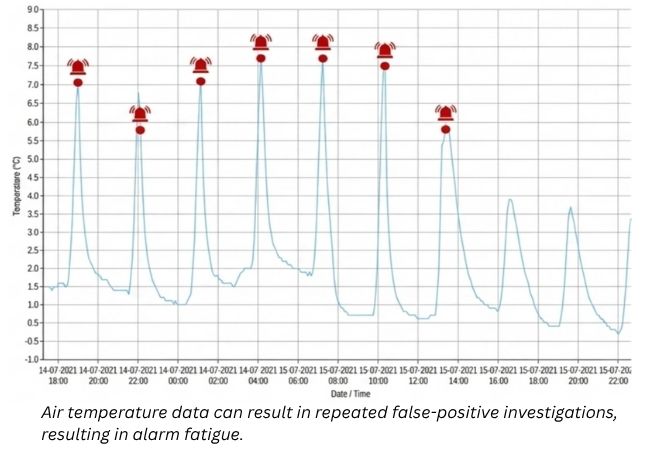
The obvious response is to investigate the temperature. How high or low did it go? When did the excursion begin? How long did it last? What products were affected?
These are essential questions, but temperature itself may not explain why the event happened.
Imagine a commercial refrigerator that normally maintains a stable internal temperature. Over several days, its compressor begins running for longer. The surrounding room becomes warmer. Staff are opening the door more frequently than normal and stock has been positioned too close to an air vent.
The unit may still maintain the required temperature initially but its ability to recover becomes slower. A routine door opening that previously caused only a minor fluctuation may now result in a longer rise. Eventually, the temperature crosses the alarm threshold.
The alarm identifies the excursion. It does not necessarily identify the chain of events that led to it.
Understanding those preceding conditions can provide useful context when teams investigate why refrigeration performance has changed.
- Compressor behaviour: is the fridge working harder?
The compressor is central to most commercial refrigeration systems. It helps circulate refrigerant through the system so that heat can be removed from the refrigerated space.

A compressor naturally cycles on and off as cooling is required. The frequency and duration of those cycles can vary according to the equipment, its controls, the surrounding environment and how the fridge is being used.
For example, a refrigerator may need to work harder when:
- ambient temperatures rise.
- warm products are introduced
- doors are opened frequently.
- airflow is restricted.
- condenser performance deteriorates.
- refrigeration components become less efficient.
An increase in compressor activity does not automatically mean a fault is developing. Operational changes can create perfectly legitimate increases in cooling demand.
However, changes in normal operating patterns may provide useful information when examined alongside temperature data.
This is one reason WHO specifically identifies compressor function as one of the additional cold-chain equipment parameters attracting interest. The longer-term goal described by WHO isn’t simply collecting more data for its own sake but potentially using equipment information to understand performance over time and support earlier investigation of failures.¹
- Power quality: a hidden influence on refrigeration
When investigating a refrigeration problem, electricity supply may not be the first place people look.
However, refrigeration equipment depends on a reliable electrical supply to operate compressors, fans, controllers and other components.
WHO guidance for vaccine cold rooms and refrigeration equipment highlights the potential impact of voltage fluctuations. It recommends voltage stabilisation where fluctuations exceed specified limits and notes that unstable supply can affect refrigeration motors, compressors, relays and associated electrical equipment.²
A complete power failure is obvious. Smaller electrical disturbances may be less noticeable.
The fridge may still have lights. The display may still be operating. Staff may therefore assume that refrigeration is functioning normally.
Monitoring electricity-related conditions can provide another layer of context, particularly in locations where power supply is unreliable or where temperature-sensitive stock carries a high financial, operational or clinical value.
Power monitoring does not replace temperature monitoring. Instead, it can help answer a different question:
If temperature performance has changed, could the electricity supply be part of the explanation?
- Door openings can matter more than expected
One of the simplest influences on refrigeration performance is also one of the most common: opening the door.
Every time a fridge, freezer or cold room is opened, warmer surrounding air can enter. The refrigeration system needs to remove that additional heat.
In busy environments such as commercial kitchens, food production areas, pharmacies and laboratories, door openings can happen hundreds of times during normal operations.
Research published by the UK Food Standards Agency provides an interesting insight into this behaviour. During its Kitchen Life 2 research involving food business operators, fridge doors were observed being left open on 33% of recorded meal occasions, with an average opening duration of 43 seconds.³
The same research identifies behaviours that can influence fridge temperature, including frequent door opening and failing to leave sufficient space for cold air to circulate.
This is important because an unusual temperature pattern does not necessarily mean the refrigeration equipment itself is defective.
If temperatures repeatedly rise around certain times of day, the pattern may correspond with deliveries, food preparation, stock replenishment, shift changes or other operational activity.
That information can turn a temperature graph into something much more useful: an insight into how the equipment is actually being used.
- Recovery time can tell its own story
A short temperature increase following a door opening or restocking event is not necessarily unexpected.
What may be more informative is how the fridge responds afterwards and how quickly it returns to its normal operating range.
Consider two similar events.
In the first, a cold-room door is opened during a delivery. Temperature rises briefly and then returns quickly to its established range.
Several months later, a similar delivery creates the same initial rise, but the cold room takes significantly longer to recover.
The temperature may still remain technically acceptable, yet that changing recovery pattern could justify further investigation.
Possible factors might include additional stock load, changing ambient conditions, airflow restrictions, icing, maintenance issues or changes in equipment performance.
Looking at trends rather than isolated readings can therefore be valuable.
The NHS Specialist Pharmacy Service makes a related point in its guidance on medicine refrigeration. It advises close monitoring when a fridge moves slightly outside its normal range during everyday activities such as adding or removing stock, and recommends investigating when it does not return appropriately to its required range.⁴
A single reading answers, “What is the temperature now?”
A trend can help answer ,“Is the way this fridge behaves changing?”
- Humidity and the wider storage environment
Temperature is not the only environmental condition that can matter in controlled storage.
Humidity can influence condensation, frost formation, packaging and the general environment around refrigerated products. Warm, humid air entering a freezer can also contribute to moisture freezing on cold surfaces.
Its importance will vary significantly according to the application. Humidity monitoring that is essential in one controlled environment may add little value in another.
Nevertheless, major cold-chain guidance increasingly acknowledges the wider storage environment.
WHO includes humidity among the additional parameters that could potentially be incorporated into equipment monitoring.¹
European Commission Good Distribution Practice guidance for medicinal products takes a similarly broad approach. It states that environmental factors to be considered in storage include temperature, light, humidity and cleanliness, and calls for temperature mapping and appropriately positioned monitoring equipment based on identified risk.⁵
The lesson is not that every organisation should immediately monitor every possible variable, but that monitoring should reflect the risks of the environment rather than relying automatically on a single measurement.
- Airflow, loading and what happens inside the fridge
A refrigerator may display an acceptable temperature while conditions differ elsewhere within the storage space.
Cold air needs to circulate. If stock is packed too tightly, vents are obstructed or products are positioned incorrectly, temperature distribution can become less uniform.
The Food Standards Agency advises against overfilling refrigerators specifically so that air can circulate and the required temperature can be maintained.³
NHS guidance for pharmacy refrigeration makes a similar recommendation. It advises keeping stock positioned so that chilled air can move around the storage chamber and warns against overstocking because of the potential for cold and warm spots.⁴
This demonstrates why the context surrounding a temperature reading matters.
A stable sensor reading does not automatically prove that every location inside a large cabinet, cold room or warehouse is experiencing identical conditions.
For higher-risk environments, temperature mapping and careful positioning of monitoring points can help identify areas most susceptible to fluctuations.
From alarms to earlier warning
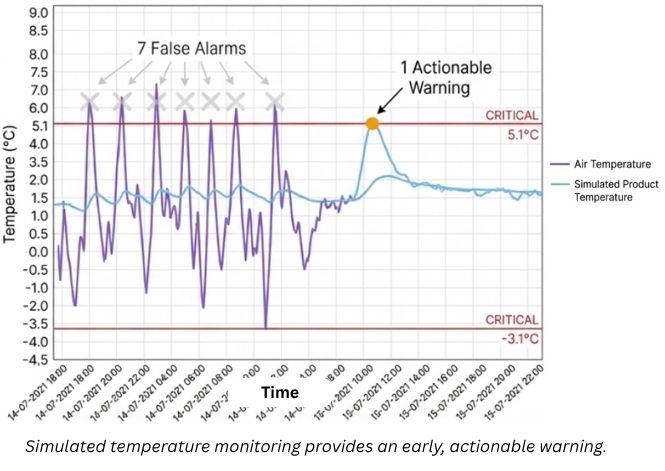
- Traditional temperature alarms answer an essential question, “Has the temperature crossed the limit?”
- The next stage in monitoring is potentially more interesting, “Is something changing that could cause the temperature to cross the limit later?”
That distinction moves monitoring towards early warning.
For example, a team might notice that:
- recovery following door openings is becoming progressively slower.
- a fridge is spending more time close to its upper temperature limit.
- compressor activity appears different from its established pattern.
- particular periods of heavy operational activity repeatedly coincide with fluctuations.
- ambient temperature is placing increased demand on equipment.
- power interruptions repeatedly precede temperature instability.
None of these observations alone proves that equipment is about to fail.
But viewed together and over time, they may provide an opportunity to investigate before a serious excursion occurs.
WHO’s direction of travel is notable in this respect. Its equipment-monitoring guidance explicitly discusses using additional equipment parameters to gain deeper insights into cold-chain performance, with the longer-term possibility of predictive failure responses and reduced equipment downtime.¹
Why earlier detection matters
The consequences of refrigeration failure extend far beyond the cost of repairing a fridge.
In food businesses, lost temperature control can affect food safety, quality and shelf life.
In hospitals, pharmacies and laboratories, temperature excursions can lead to quarantined products, investigations, documentation requirements and potentially discarded medicines or materials.
The NHS, for example, advises that when a medicine-storage temperature excursion occurs, organisations should establish what happened, determine the maximum and minimum temperatures reached, and identify how long products remained outside their recommended conditions. Continuous data loggers can provide a more detailed picture of an excursion than simple minimum/maximum recorders.⁶
There is also a much wider global issue.
A 2022 United Nations Environment Programme (UNEP) and Food and Agriculture Organisation (FAO) report estimated that inadequate cold-chain infrastructure contributes to the loss of 526 million tonnes of food, equivalent to around 12% of global food production in 2017.⁷
Reliable refrigeration is connected to food availability, waste, sustainability, public health and supply-chain resilience.
What should organisations pay attention to?
There is no universal list of variables that every fridge, freezer or cold room needs to monitor.
The right approach depends on what is being stored, the regulatory environment, the equipment, the value and sensitivity of the products and the consequences of failure.
However, when reviewing refrigeration risk, organisations can consider questions such as:
- Is temperature performance stable over time?

Could ambient temperature or humidity be affecting performance? - Is the equipment recovering normally after loading or door openings?
- Are particular times, shifts or activities associated with repeated fluctuations?
- Is airflow being restricted by stock?
- Are doors closing and sealing correctly?
- Could ambient temperature or humidity be affecting performance?
- Is electricity supply stable?
- Are maintenance requirements becoming more frequent?
- Are alarms set early enough to allow meaningful action?
- Are trends being reviewed, rather than records simply being stored?
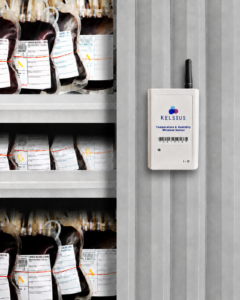
The objective is not necessarily to collect more data. It is to collect useful data that helps people make better decisions.
Looking beyond the temperature alarm
Temperature remains fundamental to refrigerated storage. For many applications, it is the measurement that ultimately determines whether storage conditions have remained acceptable.
But temperature can also be the final link in a much longer chain of events.
A door may have been opening more frequently. Airflow may have changed. Ambient conditions may have become more demanding. Electrical supply may have been unstable. Equipment may have been taking progressively longer to recover.
By the time the temperature finally crosses its alarm threshold, the underlying problem may already have been developing for some time.
Understanding what happens before the fridge fails could help organisations move from simply reacting to excursions towards recognising changing conditions earlier, investigating potential causes sooner and protecting temperature-sensitive products before an alarm becomes a crisis.
For advice on where to start with automated temperature and humidity monitoring or advice on temperature mapping, contact Kelsius.
Sources
- World Health Organization (WHO), Prequalification of Immunization Devices – E006: Temperature Monitoring Devices. WHO describes the introduction of Equipment Monitoring Systems and the potential monitoring of temperature alongside voltage input, humidity and compressor function. WHO – E006 Temperature Monitoring Devices
- World Health Organization (WHO), E001: Cold Rooms, Freezer Rooms and Related Equipment. Guidance covering voltage fluctuations, electrical protection and environmental conditions affecting refrigeration equipment. WHO – E001 Cold Rooms and Freezer Rooms
- Food Standards Agency, Storing chilled foods at incorrect temperatures. Research from the Kitchen Life 2 programme examining fridge temperatures and behaviours including door opening and overfilling. Food Standards Agency – Storing chilled foods at incorrect temperatures
- NHS Specialist Pharmacy Service, Using a refrigerator or freezer to store medicines. Guidance on installation, airflow, monitoring, fridge use and maintenance. NHS SPS – Using a refrigerator or freezer to store medicines
- European Commission, Guidelines on Good Distribution Practice of medicinal products for human use (2013/C 343/01). Guidance covering temperature mapping, environmental monitoring, humidity and maintenance of storage equipment. EUR-Lex – EU Good Distribution Practice Guidelines
- NHS Specialist Pharmacy Service, Managing temperature excursions. Guidance on investigating refrigeration excursions and the information needed to assess their significance. NHS SPS – Managing temperature excursions
- United Nations Environment Programme, Sustainable Cold Chains. UNEP summary of the UNEP-FAO Sustainable Food Cold Chains report and global food-loss estimates. UNEP – Sustainable Cold Chains