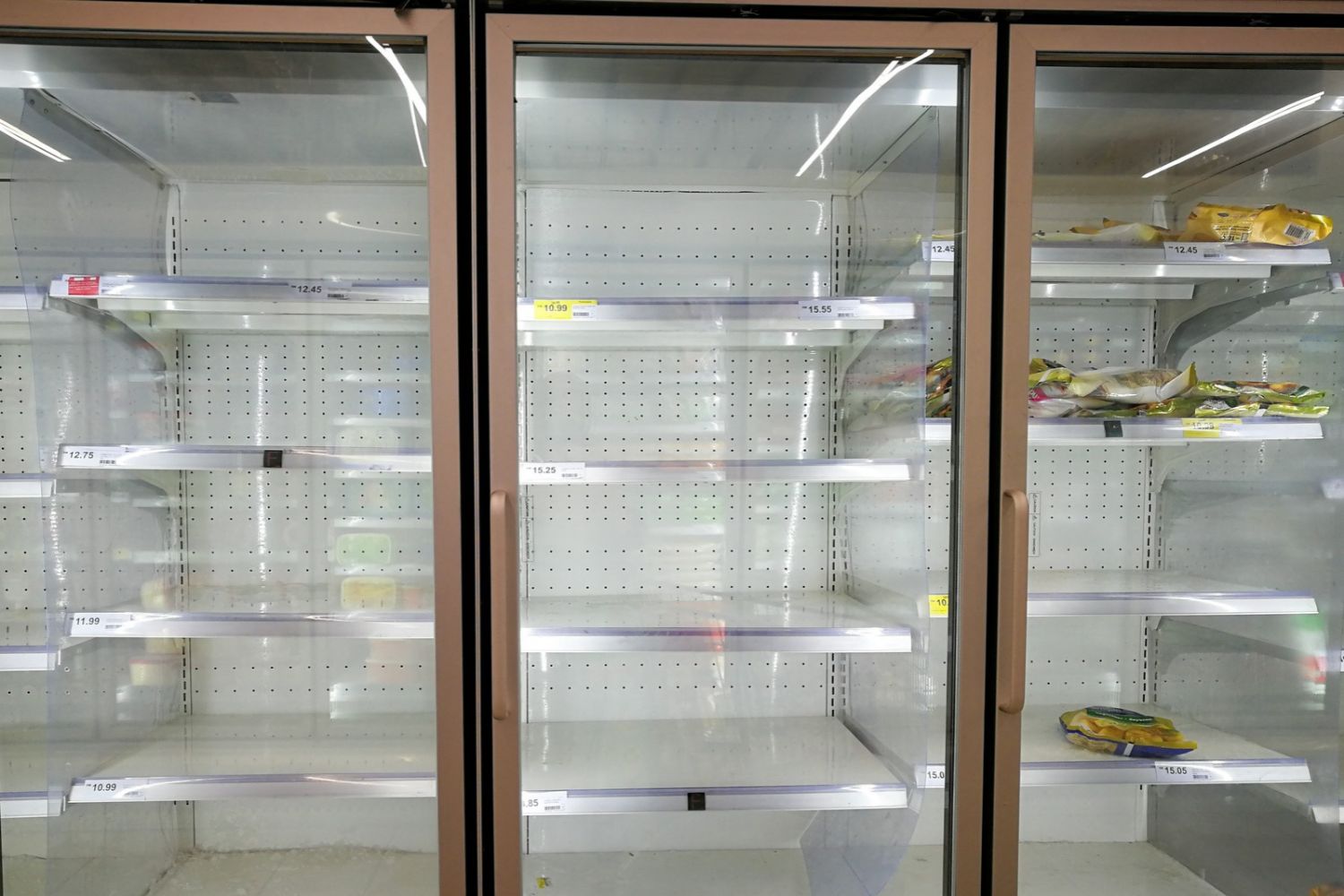
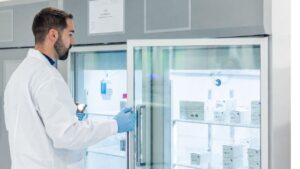
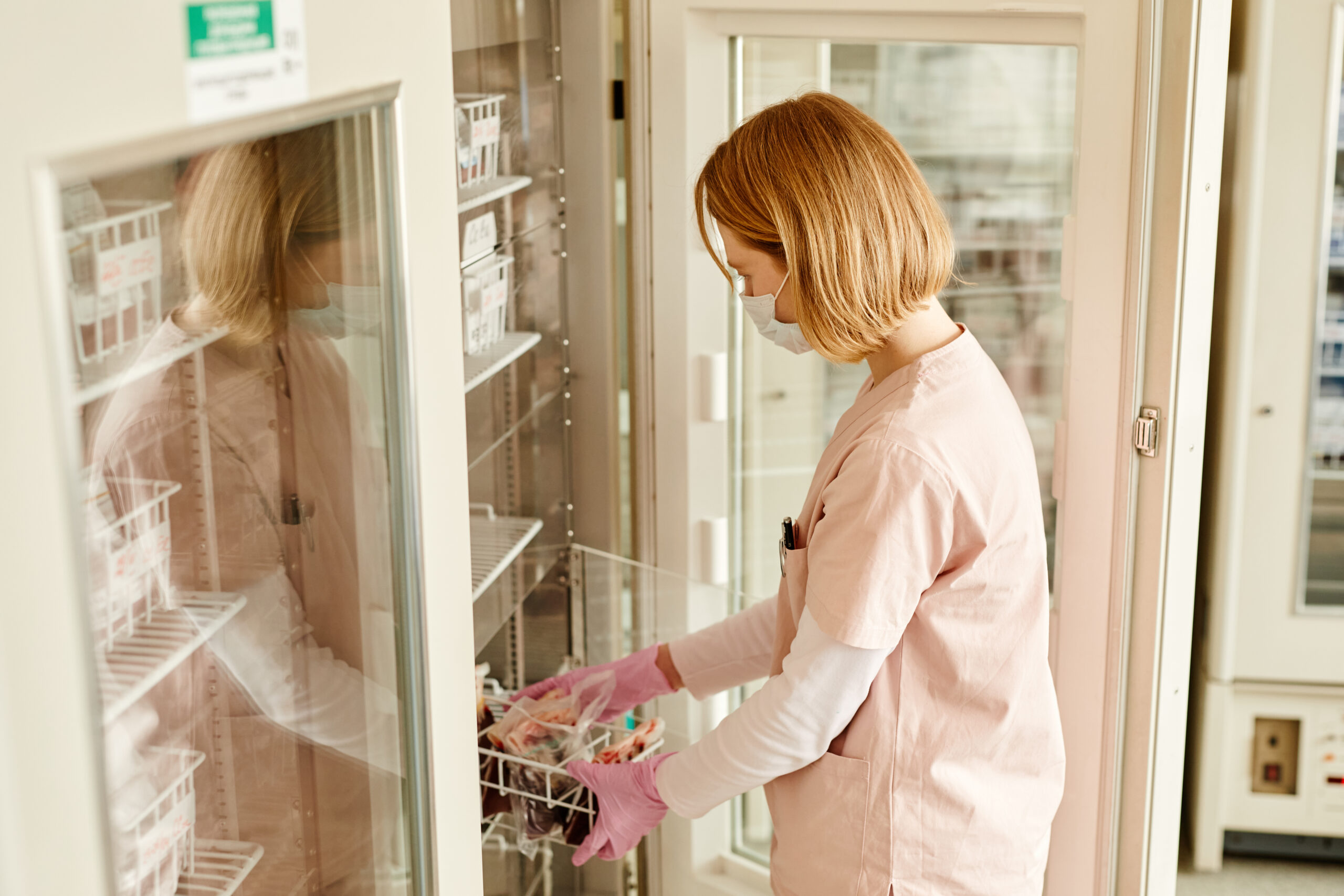
On the night of 11 to 12 October 2026, an overnight cyberattack affected refrigeration systems in hundreds of French supermarkets. Fresh and frozen products had to be discarded after temperatures rose. The incident has highlighted concerns about outdated firmware and equipment that no longer received security updates. As the incident continues to be investigated, the practical consequences included disrupted stores, significant amounts of food waste, and financial losses.
The incident raises questions for every food business using connected technology. How well are we protecting the systems we depend on to keep food safe?
A fridge can look perfectly normal from the outside while the food inside is becoming unsafe. In a connected food business, the cause could be a mechanical fault, a power failure or something less visible like a cyberattack on the system controlling refrigeration.
The digitalisation of food safety management
Managers of food businesses are responsible for a mix of refrigeration units, storage areas, deliveries, hygiene checks, records and regulatory responsibilities (as well as delivering service to customers and managing teams). Much of this work continues around the clock, even when the premises are closed and staff have gone home.
Connected equipment, digital records and temperature monitoring can improve visibility and reduce reliance on someone being physically present to spot a problem. For businesses operating across several locations, these tools can make essential information easier to access and act on.
However, connectivity can also create extra work and responsibilities. The UK’s National Cyber Security Centre warns that increasingly connected operational technology brings security risks alongside benefits such as remote monitoring and maintenance. A cyber incident affecting physical equipment can have consequences beyond the loss of data.
For food business managers, cybersecurity adds a layer of responsibility about operational continuity and food safety, alongside equipment maintenance and staff training.
The role of technology
The French incident provides businesses with a timely reminder to check the technology behind their refrigeration. A unit may keep food cold today while outdated software leaves its controls vulnerable to interference tomorrow.
Start by identifying your connected equipment, its software or firmware version and its support status. Firmware is the software embedded in equipment such as refrigeration controllers. Ask your supplier which systems still receive security updates, and which need an upgrade or replacement.
Make updates part of planned maintenance. Agree who tracks security notices, who installs updates and who checks that the equipment operates correctly afterwards. Work with qualified technicians to schedule and test changes without compromising refrigeration.
If a supplier no longer supports a controller, establish a replacement plan and ask your technical team how to reduce its exposure in the meantime. Do not assume that a functioning fridge has a secure control system.
Control who can access connected equipment
Remote access helps suppliers diagnose faults and maintain equipment, but businesses need to retain control over who can access their equipment.
Change default passwords, give each authorised user an individual account where supported, and restrict permissions to the tasks they need to perform. Protect remote access with multi-factor authentication and remove access when a staff member or contractor no longer needs it.
Ask your IT provider to separate refrigeration controls from guest Wi-Fi and other networks appropriately. Suppliers should use a secure, controlled route for remote support.
These steps reflect National Cyber Security Centre guidance on protecting operational technology. They reduce opportunities for unauthorised access and help limit the consequences if another part of the business’s network suffers an attack.
Choose suppliers who take security seriously
Reliable technology needs reliable support throughout its working life. Ask suppliers to explain their security arrangements in clear terms before you purchase a system, and review those arrangements regularly.
How long will they provide security updates? How quickly will they notify you about a vulnerability or service disruption? Who handles urgent issues outside office hours? What happens when equipment reaches the end of its supported life?
Request clear responsibilities and contact details. Make sure you have a nominated person responsible for coordinating security updates.
Automated alerts allow for faster reactions
Prevention reduces risk. Automated monitoring helps businesses act when a problem still occurs, whether a cyberattack, equipment fault or power failure causes it.
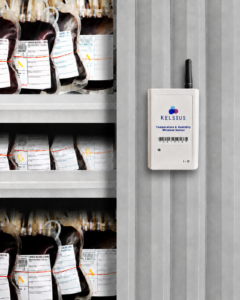
Configure your monitoring system to send notifications as soon as it detects a condition that meets the agreed alert criteria. Those notifications need to reach the responsible people at any hour, including overnight, at weekends and during holidays.
Use suitable channels, such as push notifications, email or voice calls, according to the system’s capabilities and the urgency of the issue.
Set alert thresholds around your food safety procedures. Check how frequently the system measures temperatures and how quickly it delivers notifications. An immediate notification after detection still depends on those settings and a working communication route.
Where supported, enable alerts for missing readings, lost connections and device faults too. A monitoring system that stops reporting needs attention, even if it has not recorded a temperature breach.
Make sure alerts reach someone who can act
An alert at 2am only helps if someone receives it and takes responsibility.
Create an out-of-hours contact rota, assign a backup and set an escalation process for unacknowledged alerts. Keep phone numbers and app settings current. Test the notification route and response arrangements regularly, including outside normal working hours.
Give staff a clear action plan. Identify who can access the premises, contact an engineer and authorise stock movement. Arrange alternative refrigerated storage in advance and confirm that it offers suitable conditions and enough capacity.
Early notification may give a team time to move products before conditions deteriorate further. If stock has already become unsafe, it can still help managers restrict sales, arrange disposal and bring in cleaning teams before customers arrive.
Reducing the impact of fridge failures
Temperature monitoring detects changes in storage conditions; it does not necessarily identify their cause. Businesses still need cybersecurity controls to protect equipment and investigate suspicious activity.
For businesses holding substantial chilled or frozen stock, an incident could put tens of thousands of euro worth of food at risk. Disposal, repairs, cleaning and interrupted trading can add to the cost.
The lesson from France highlights the importance of maintaining supported technology, controlling access and establishing clear communications with suppliers. Make sure that your food safety plan continues after closing time, and not just during business hours.
For advice on automated temperature monitoring and 24-hour, real-time temperature alerts, contact Kelsius.
Sources
BBC News, 13 October: Fridges in French supermarkets hit by cyber attack https://www.bbc.com/news/articles/crq5nzxv9q4yo
National Cyber Security Centre: Secure connectivity principles for operational technology. https://www.ncsc.gov.uk/collection/operational-technology/secure-connectivity/introduction
NCSC: Principle 5, Harden your OT boundary. https://www.ncsc.gov.uk/collection/operational-technology/secure-connectivity/principle-5
NCSC: Principle 7, Ensure all connectivity is logged and monitored. https://www.ncsc.gov.uk/collection/operational-technology/secure-connectivity/principle-7
Food Safety Authority of Ireland: Principles of HACCP. https://www.fsai.ie/business-advice/running-a-food-business/food-safety-management-system-%28haccp%29/principles-of-haccp
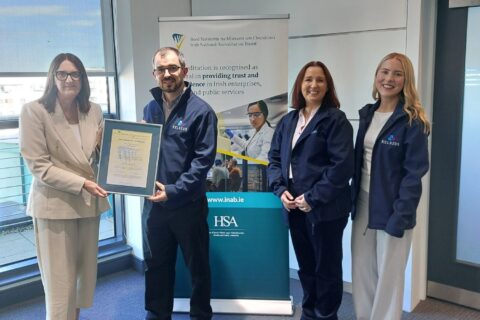
ISO/IEC 17025 accreditation demonstrates Kelsius’ technical competence and commitment to accurate, reliable calibration services
Donegal, Ireland, 07 September 2026 – Kelsius is proud to announce that it has achieved accreditation for Temperature Calibration within the scope of -35°C to +50°C from the Irish National Accreditation Board (INAB) to ISO/IEC 17025, the internationally recognised standard for the competence of testing and calibration laboratories.
The accreditation follows an independent assessment of Kelsius’ calibration services in relation to technical competence, calibration procedures, quality management system, equipment, measurement traceability and ability to deliver reliable calibration results within its accredited scope.
This significant achievement provides Kelsius customers with additional confidence that applicable calibration work is carried out by technically competent personnel using controlled procedures and appropriately maintained equipment.
“Achieving INAB accreditation is an important milestone for Kelsius and reflects the expertise, commitment and attention to detail of our team,” said Sabrina Finnegan, Operations Manager at Kelsius.
ISO/IEC 17025 is the international standard used to assess the competence, impartiality and consistent operation of testing and calibration laboratories. INAB is Ireland’s national body responsible for accrediting laboratories and other conformity assessment bodies.
The accreditation further strengthens the quality and technical capabilities supporting Kelsius’ range of temperature monitoring and digital compliance solutions across the food, life sciences and healthcare sectors.
It forms part of the company’s continued investment in quality, technical expertise and reliable customer support.
A fridge rarely goes from working perfectly to complete failure without something changing first.
Before a temperature alarm sounds, there may already have been warning signs: the compressor running for longer than usual, repeated door openings, poor airflow, rising ambient temperature, unstable electricity supply or an unusually slow recovery after stock has been loaded.
For businesses responsible for temperature-sensitive products, this raises an important question. Are we monitoring the problem, or simply monitoring the final symptom?
Temperature will always be one of the most important measurements in refrigerated storage. It tells us whether food, medicines, laboratory materials and other temperature-sensitive products are being stored within their required conditions.
However, developments in cold-chain monitoring suggest that there is growing interest in looking beyond just temperature.
The World Health Organization (WHO) states that from 2026 all vaccine refrigerators covered by its prequalification framework are required to have an Equipment Monitoring System (EMS). While WHO describes temperature as the most essential vaccine safety indicator, it also identifies increasing potential to monitor additional parameters including voltage input, humidity and compressor function. WHO suggests that collecting this wider range of information could eventually support remote failure analysis and more predictive responses to equipment problems.¹
Although these requirements relate specifically to vaccine refrigeration, the principle raises a much wider question for any organisation that depends on reliable refrigeration.
What happens before a fridge fails?
A temperature excursion occurs when a refrigerated or frozen storage area moves outside its established temperature limits.
The obvious response is to investigate the temperature. How high or low did it go? When did the excursion begin? How long did it last? What products were affected?
These are essential questions, but temperature itself may not explain why the event happened.
Imagine a commercial refrigerator that normally maintains a stable internal temperature. Over several days, its compressor begins running for longer. The surrounding room becomes warmer. Staff are opening the door more frequently than normal and stock has been positioned too close to an air vent.
The unit may still maintain the required temperature initially but its ability to recover becomes slower. A routine door opening that previously caused only a minor fluctuation may now result in a longer rise. Eventually, the temperature crosses the alarm threshold.
The alarm identifies the excursion. It does not necessarily identify the chain of events that led to it.
Understanding those preceding conditions can provide useful context when teams investigate why refrigeration performance has changed.
Compressor behaviour: is the fridge working harder?
The compressor is central to most commercial refrigeration systems. It helps circulate refrigerant through the system so that heat can be removed from the refrigerated space.
The compressor is central to commercial refrigeration units.
A compressor naturally cycles on and off as cooling is required. The frequency and duration of those cycles can vary according to the equipment, its controls, the surrounding environment and how the fridge is being used.
For example, a refrigerator may need to work harder when:
ambient temperatures rise.
warm products are introduced
doors are opened frequently.
airflow is restricted.
condenser performance deteriorates.
refrigeration components become less efficient.
An increase in compressor activity does not automatically mean a fault is developing. Operational changes can create perfectly legitimate increases in cooling demand.
However, changes in normal operating patterns may provide useful information when examined alongside temperature data.
This is one reason WHO specifically identifies compressor function as one of the additional cold-chain equipment parameters attracting interest. The longer-term goal described by WHO isn’t simply collecting more data for its own sake but potentially using equipment information to understand performance over time and support earlier investigation of failures.¹
Power quality: a hidden influence on refrigeration
When investigating a refrigeration problem, electricity supply may not be the first place people look.
However, refrigeration equipment depends on a reliable electrical supply to operate compressors, fans, controllers and other components.
WHO guidance for vaccine cold rooms and refrigeration equipment highlights the potential impact of voltage fluctuations. It recommends voltage stabilisation where fluctuations exceed specified limits and notes that unstable supply can affect refrigeration motors, compressors, relays and associated electrical equipment.²
A complete power failure is obvious. Smaller electrical disturbances may be less noticeable.
The fridge may still have lights. The display may still be operating. Staff may therefore assume that refrigeration is functioning normally.
Monitoring electricity-related conditions can provide another layer of context, particularly in locations where power supply is unreliable or where temperature-sensitive stock carries a high financial, operational or clinical value.
Power monitoring does not replace temperature monitoring. Instead, it can help answer a different question:
If temperature performance has changed, could the electricity supply be part of the explanation?
Door openings can matter more than expected
One of the simplest influences on refrigeration performance is also one of the most common: opening the door.
Every time a fridge, freezer or cold room is opened, warmer surrounding air can enter. The refrigeration system needs to remove that additional heat.
In busy environments such as commercial kitchens, food production areas, pharmacies and laboratories, door openings can happen hundreds of times during normal operations.
Research published by the UK Food Standards Agency provides an interesting insight into this behaviour. During its Kitchen Life 2 research involving food business operators, fridge doors were observed being left open on 33% of recorded meal occasions, with an average opening duration of 43 seconds.³
The same research identifies behaviours that can influence fridge temperature, including frequent door opening and failing to leave sufficient space for cold air to circulate.
This is important because an unusual temperature pattern does not necessarily mean the refrigeration equipment itself is defective.
If temperatures repeatedly rise around certain times of day, the pattern may correspond with deliveries, food preparation, stock replenishment, shift changes or other operational activity.
That information can turn a temperature graph into something much more useful: an insight into how the equipment is actually being used.
Recovery time can tell its own story
A short temperature increase following a door opening or restocking event is not necessarily unexpected.
What may be more informative is how the fridge responds afterwards and how quickly it returns to its normal operating range.
Consider two similar events.
In the first, a cold-room door is opened during a delivery. Temperature rises briefly and then returns quickly to its established range.
Several months later, a similar delivery creates the same initial rise, but the cold room takes significantly longer to recover.
The temperature may still remain technically acceptable, yet that changing recovery pattern could justify further investigation.
Possible factors might include additional stock load, changing ambient conditions, airflow restrictions, icing, maintenance issues or changes in equipment performance.
Looking at trends rather than isolated readings can therefore be valuable.
NHS Specialist Pharmacy Service advises close monitoring if a fridge is outside its normal range during everyday activities.
The NHS Specialist Pharmacy Service makes a related point in its guidance on medicine refrigeration. It advises close monitoring when a fridge moves slightly outside its normal range during everyday activities such as adding or removing stock, and recommends investigating when it does not return appropriately to its required range.⁴
A single reading answers, “What is the temperature now?”
A trend can help answer ,“Is the way this fridge behaves changing?”
Humidity and the wider storage environment
Temperature is not the only environmental condition that can matter in controlled storage.
Humidity can influence condensation, frost formation, packaging and the general environment around refrigerated products. Warm, humid air entering a freezer can also contribute to moisture freezing on cold surfaces.
Its importance will vary significantly according to the application. Humidity monitoring that is essential in one controlled environment may add little value in another.
Nevertheless, major cold-chain guidance increasingly acknowledges the wider storage environment.
WHO includes humidity among the additional parameters that could potentially be incorporated into equipment monitoring.¹
European Commission Good Distribution Practice guidance for medicinal products takes a similarly broad approach. It states that environmental factors to be considered in storage include temperature, light, humidity and cleanliness, and calls for temperature mapping and appropriately positioned monitoring equipment based on identified risk.⁵
The lesson is not that every organisation should immediately monitor every possible variable, but that monitoring should reflect the risks of the environment rather than relying automatically on a single measurement.
Airflow, loading and what happens inside the fridge
A refrigerator may display an acceptable temperature while conditions differ elsewhere within the storage space.
Cold air needs to circulate. If stock is packed too tightly, vents are obstructed or products are positioned incorrectly, temperature distribution can become less uniform.
The Food Standards Agency advises against overfilling refrigerators specifically so that air can circulate and the required temperature can be maintained.³
NHS guidance for pharmacy refrigeration makes a similar recommendation. It advises keeping stock positioned so that chilled air can move around the storage chamber and warns against overstocking because of the potential for cold and warm spots.⁴
This demonstrates why the context surrounding a temperature reading matters.
A stable sensor reading does not automatically prove that every location inside a large cabinet, cold room or warehouse is experiencing identical conditions.
For higher-risk environments, temperature mapping and careful positioning of monitoring points can help identify areas most susceptible to fluctuations.
From alarms to earlier warning
Traditional temperature alarms answer an essential question, “Has the temperature crossed the limit?”
The next stage in monitoring is potentially more interesting, “Is something changing that could cause the temperature to cross the limit later?”
That distinction moves monitoring towards early warning.
For example, a team might notice that:
recovery following door openings is becoming progressively slower.
a fridge is spending more time close to its upper temperature limit.
compressor activity appears different from its established pattern.
particular periods of heavy operational activity repeatedly coincide with fluctuations.
ambient temperature is placing increased demand on equipment.
power interruptions repeatedly precede temperature instability.
None of these observations alone proves that equipment is about to fail.
But viewed together and over time, they may provide an opportunity to investigate before a serious excursion occurs.
WHO’s direction of travel is notable in this respect. Its equipment-monitoring guidance explicitly discusses using additional equipment parameters to gain deeper insights into cold-chain performance, with the longer-term possibility of predictive failure responses and reduced equipment downtime.¹
Why earlier detection matters
The consequences of refrigeration failure extend far beyond the cost of repairing a fridge.
In food businesses, lost temperature control can affect food safety, quality and shelf life.
In hospitals, pharmacies and laboratories, temperature excursions can lead to quarantined products, investigations, documentation requirements and potentially discarded medicines or materials.
The NHS, for example, advises that when a medicine-storage temperature excursion occurs, organisations should establish what happened, determine the maximum and minimum temperatures reached, and identify how long products remained outside their recommended conditions. Continuous data loggers can provide a more detailed picture of an excursion than simple minimum/maximum recorders.⁶
There is also a much wider global issue.
A 2022 United Nations Environment Programme (UNEP) and Food and Agriculture Organisation (FAO) report estimated that inadequate cold-chain infrastructure contributes to the loss of 526 million tonnes of food, equivalent to around 12% of global food production in 2017.⁷
Reliable refrigeration is connected to food availability, waste, sustainability, public health and supply-chain resilience.
What should organisations pay attention to?
There is no universal list of variables that every fridge, freezer or cold room needs to monitor.
The right approach depends on what is being stored, the regulatory environment, the equipment, the value and sensitivity of the products and the consequences of failure.
However, when reviewing refrigeration risk, organisations can consider questions such as:
Is temperature performance stable over time?
Could ambient temperature or humidity be affecting performance?
Is the equipment recovering normally after loading or door openings?
Are particular times, shifts or activities associated with repeated fluctuations?
Is airflow being restricted by stock?
Are doors closing and sealing correctly?
Could ambient temperature or humidity be affecting performance?
Is electricity supply stable?
Are maintenance requirements becoming more frequent?
Are alarms set early enough to allow meaningful action?
Are trends being reviewed, rather than records simply being stored?
The objective is not necessarily to collect more data. It is to collect useful data that helps people make better decisions.
Looking beyond the temperature alarm
Temperature remains fundamental to refrigerated storage. For many applications, it is the measurement that ultimately determines whether storage conditions have remained acceptable.
But temperature can also be the final link in a much longer chain of events.
A door may have been opening more frequently. Airflow may have changed. Ambient conditions may have become more demanding. Electrical supply may have been unstable. Equipment may have been taking progressively longer to recover.
By the time the temperature finally crosses its alarm threshold, the underlying problem may already have been developing for some time.
Understanding what happens before the fridge fails could help organisations move from simply reacting to excursions towards recognising changing conditions earlier, investigating potential causes sooner and protecting temperature-sensitive products before an alarm becomes a crisis.
For advice on where to start with automated temperature and humidity monitoring or advice on temperature mapping, contact Kelsius.
Sources
World Health Organization (WHO), Prequalification of Immunization Devices – E006: Temperature Monitoring Devices. WHO describes the introduction of Equipment Monitoring Systems and the potential monitoring of temperature alongside voltage input, humidity and compressor function. WHO – E006 Temperature Monitoring Devices
World Health Organization (WHO), E001: Cold Rooms, Freezer Rooms and Related Equipment. Guidance covering voltage fluctuations, electrical protection and environmental conditions affecting refrigeration equipment. WHO – E001 Cold Rooms and Freezer Rooms
European Commission, Guidelines on Good Distribution Practice of medicinal products for human use (2013/C 343/01). Guidance covering temperature mapping, environmental monitoring, humidity and maintenance of storage equipment. EUR-Lex – EU Good Distribution Practice Guidelines
NHS Specialist Pharmacy Service, Managing temperature excursions. Guidance on investigating refrigeration excursions and the information needed to assess their significance. NHS SPS – Managing temperature excursions
United Nations Environment Programme, Sustainable Cold Chains. UNEP summary of the UNEP-FAO Sustainable Food Cold Chains report and global food-loss estimates. UNEP – Sustainable Cold Chains
The Marine Institute operates laboratories that require environmental and temperature-controlled equipment to ensure the integrity of samples, reagents, reference materials, and analytical processes. The Kelsius system provides the Marine Institute with real-time monitoring and automated alerts, enabling rapid response to temperature excursions and reducing the risk of sample loss or compromised analytical results.
The team at the Marine Institute found the web-based Kelsius platform user-friendly, allowing authorised personnel to access monitoring data and historical records easily, supporting both operational oversight and audit requirements.
“Since implementing the Kelsius system in 2017, we have found it to be an excellent, reliable and effective system for continuous temperature monitoring across our laboratory facilities”, said Yvonne Bogan, Quality Manager at the Marine Institute.
She continued: “We found the Kelsius team to be professional, responsive, and supportive throughout installation, validation, training, and ongoing system maintenance. Any technical queries or service requests have been addressed promptly and effectively.
“From a quality management perspective, the Kelsius system just runs reliably in the background providing confidence that critical temperature-controlled equipment remains under constant surveillance.”
Enhanced Compliance
For quality management, Kelsius helps The Marine Institute to meet accreditation requirements by providing:
secure data logging
traceable records
comprehensive reporting capabilities
enhanced compliance with quality standards
the ability to streamline evidence-gathering during audits
Contact Kelsius to learn more about automated temperature monitoring to protect samples and products in laboratories.
Kelsius is proud to continue its association with National Craft Butchers (NCB) and its members as a sponsor of the upcoming NCB Product Awards 2026.
The NCB Product Awards are an opportunity to showcase the craft butchery industry. They recognise the businesses and teams that go above and beyond to create exceptional products, consistent quality and fresh innovation. From traditional favourites to new product ideas, the awards highlight the talent and dedication that make independent butchers such an important part of local communities.
This year, Kelsius is delighted to sponsor the Hot Eating Pie category, supporting one of the standout product areas in craft butchery and celebrating the skill, creativity and quality that butchers across the UK bring to their counters every day.
For Kelsius, supporting the awards is a natural extension of its work with butchers and food businesses. Kelsius helps butchers manage food safety, compliance and daily checks with greater confidence through its digital HACCP and automated temperature monitoring solutions. Kelsius is proud to work alongside businesses that put quality, safety and customer trust at the centre of everything they do.
Speaking about the awards, Keith Burke, Sales Manager for Butchery & Food Manufacturing at Kelsius, said, “Kelsius has built a strong relationship with National Craft Butchers over the years, and we are always delighted to support the organisation and its members. Craft butchers are passionate about quality, consistency and customer service, and we are proud to help them manage food safety and compliance in a practical, reliable way. The NCB Product Awards are a brilliant opportunity to celebrate the skills and innovation within the industry. I’m really looking forward to seeing the products that this year’s competition produces.”
The 2026 awards include a wide range of categories, giving craft butchers the opportunity to showcase the very best of their product range. Categories include Hot Eating Pie, Cold Eating Pie, Traditional Sausage, Innovative Sausage, Traditional Bacon, Innovative Bacon, Traditional Black Pudding, Best 30-Minute Meal, and Best Game Product.
Additional new categories for 2026 include Best Delicatessen Meats and Charcuterie, Best BBQ Product, and Best Delicatessen Product.
Recognition at the NCB Product Awards can help build customer confidence and give teams well-earned recognition. It is also a valuable opportunity for butchers to benchmark their products and celebrate the hard work that goes into producing high-quality food every day.
Entries are now open and close on Monday 17 August 2026 or earlier if categories reach capacity. So butchers are encouraged to submit their entries as soon as possible with the NCB here.
Judging will take place on Friday 4 September 2026 at Harper Adams University, where products will be assessed through blind tasting by an experienced panel of industry experts. Winners will be announced in October.
Kelsius wishes all entrants the very best of luck and looks forward to celebrating the businesses helping to shape the future of craft butchery.
Contact Kelsius to learn more about automated temperature monitoring for butchers with real-time alerts.
In recent years Europe is repeatedly experiencing summer heatwaves, with June heatwaves becoming increasingly common particularly in Spain. Spain’s state weather service, Aemet, reports 10 recorded heatwaves in June in mainland Spain between 2000 and 2025, and just two in the previous 25 years1.
Other countries are similarly experiencing hotter temperatures and more frequent heatwaves. As well as the impact this has on the lives and health of people, high temperatures can also affect the safety of temperature-sensitive products.
When temperatures rise, fridges and freezers become even more critical to food safety, product quality and compliance. For food businesses, healthcare sites, laboratories, pharmacies, hospitality operators and cold-chain teams, unusually hot weather can place refrigeration equipment under additional pressure. The unit may still appear to be running normally, but behind the scenes the system is often working harder to maintain the required temperature.
This matters because chilled and frozen products rely on stable storage conditions. If a fridge or freezer can’t remove heat quickly enough, internal temperatures can rise. Even short periods outside the correct temperature range can increase food safety risk, affect product quality, reduce shelf life or create compliance issues.
Understanding how refrigeration systems operate, and why hot weather can make their job more difficult, helps businesses prepare before problems occur.
How fridges and freezers normally work
Most commercial fridges and freezers operate using a vapour compression refrigeration cycle. While the equipment can vary in size, from an upright fridge to a walk-in freezer or cold room, the basic principle is the same.
The purpose of the system is to remove heat from inside the cabinet, room or storage area and release that heat outside the cooled space. It does not “create cold” in the way many people imagine. Instead, it continuously moves heat from one place to another.
The main components involved are:
The evaporator: This sits inside the cooled area. Refrigerant passes through the evaporator at a low temperature and absorbs heat from the air inside the fridge or freezer.
The compressor: The compressor pumps refrigerant around the system. It raises the pressure and temperature of the refrigerant so that the absorbed heat can be released.
The condenser: The condenser is usually located outside the chilled space, often at the back, top or external plant area of the unit. Its job is to reject heat into the surrounding air.
The expansion valve or metering device: This controls the flow of refrigerant into the evaporator and reduces its pressure, allowing it to absorb heat again.
Fans and controls: Fans move air across the evaporator and condenser coils. Sensors and thermostats monitor temperature and tell the system when to switch on, run harder or switch off.
During normal operation, the thermostat detects when the internal temperature rises above the set point. The compressor starts, refrigerant circulates and the system removes heat until the required temperature is reached again. The compressor then cycles off or reduces output, depending on the type of system.
In a well-maintained unit, this process happens continuously throughout the day. Doors open, warm air enters, products are loaded, and the system responds by removing the extra heat.
What changes during extremely hot weather?
During hot weather, the fridge or freezer still works in the same technical way. The refrigeration cycle does not change. However, the conditions around the equipment change significantly.
A fridge that performs adequately in mild conditions may struggle when temperatures rise.
The most important factor is the difference between the temperature inside the unit and the temperature outside it. A fridge may be trying to hold food at around 5°C or below, while the surrounding room might be 28°C or higher. A freezer may be trying to maintain frozen products at around -18°C while rejecting heat into very warm ambient air.
This wider temperature difference creates a higher heat load. More heat enters the cabinet through door openings, walls, seals and product loading. At the same time, the condenser has to reject heat into air that’s already warm. That makes the process less efficient.
In practical terms, the system may need to run for longer periods. The compressor may cycle on more frequently. Fans may operate more often. Defrost cycles may become more important. Any weakness in the equipment, such as dirty condenser coils, worn door seals, poor airflow or low refrigerant charge, can become more noticeable during hot weather.
A fridge or freezer that performs adequately in mild conditions may struggle when temperatures rise.
The compressor works harder
The compressor is one of the hardest-working parts of a refrigeration system. During hot weather, it may be under increased pressure because the system needs to remove more heat and run for longer.
When the condenser is exposed to high ambient temperatures, the refrigerant may not reject heat as easily. This can increase the pressure on the high side of the system. The compressor then has to work harder to move refrigerant and maintain the required cooling effect.
Longer run times can increase wear. Higher operating pressures can increase stress. Electrical components may also run hotter. If the compressor is already ageing, poorly maintained or operating in a poorly ventilated area, unusually hot weather can increase the likelihood of failure.
This does not mean that every fridge or freezer will break down during a heatwave. Well-designed, well-maintained equipment should be able to cope with expected operating conditions. However, hot weather reduces the margin for error. It can expose problems that were previously hidden.
The condenser has to reject heat into hotter air
The condenser is responsible for releasing heat from the refrigeration system into the surrounding environment. It works best when there is good airflow and a reasonable difference between the condenser temperature and the surrounding air temperature.
During extremely hot weather, this becomes more difficult. The air around the condenser is warmer, so heat transfer is less effective. If the condenser coil is dusty, blocked or located in a cramped plant room, the problem can become worse.
Poor condenser performance can lead to higher head pressure, longer compressor run times and reduced cooling capacity. In some cases, the system may trip on high pressure to protect itself. This can leave the fridge, freezer or cold room unable to maintain temperature until the fault is resolved.
For this reason, condenser cleaning and ventilation are particularly important before and during periods of hot weather.
Door seals, insulation and airflow become more important
Hot weather also increases the importance of the basic physical condition of the unit.
Door seals help prevent warm air entering the fridge or freezer. If seals are cracked, loose or damaged, warm air can leak into the cabinet. This forces the system to remove more heat and may lead to condensation, ice build-up or unstable internal temperatures.
Insulation also plays a key role. The walls, doors and panels of the unit are designed to slow heat transfer. If insulation is damaged or panels are poorly fitted, more heat enters the cooled space.
Airflow inside the unit is another important factor. If stock is packed too tightly or vents are blocked, cold air cannot circulate properly. This can create warm spots, even if the temperature sensor shows that part of the unit is within range. During hot weather, poor airflow can become a bigger issue because the system has less spare cooling capacity.
Fans and evaporators may be under more pressure
Evaporator fans circulate cold air around the storage area. Condenser fans help remove heat from the system. During hot weather, both may run more frequently or for longer periods.
If a fan motor is weak, obstructed or failing, the refrigeration system may not perform properly. Reduced airflow across the evaporator can affect cooling inside the cabinet. Reduced airflow across the condenser can prevent heat from being rejected effectively.
The evaporator itself can also be affected by moisture. When warm, humid air enters a fridge or freezer, especially through frequent door openings, moisture can condense or freeze on the evaporator coil. In freezers, this can contribute to ice build-up. Excessive frost can restrict airflow and reduce the system’s ability to absorb heat.
Defrost systems are designed to manage this, but if defrost cycles are not working correctly, hot weather and high humidity can make the issue more visible.
Are fridges and freezers more likely to break down in hot weather?
It’s possible, especially if they are already under-maintained, overloaded or operating in poor conditions.
Hot weather does not automatically cause refrigeration failure. Commercial units are designed to operate within specified ambient temperature ranges. However, when ambient temperature rises, the system has to work harder. Components may experience longer run times, higher pressures and greater thermal stress.
Problems that may be manageable in cooler weather can become critical in hot weather. Examples include:
Dirty condenser coils
Blocked airflow around the unit
Damaged door seals
Poorly closing doors
Overloaded cabinets
Frequent door openings
Faulty fans
Incorrect thermostat settings
Low refrigerant charge
Ageing compressors
Poorly maintained defrost systems
The risk isn’t just that a unit stops working completely. A more common issue is that it slowly struggles to maintain temperature. This can be harder to spot without continuous monitoring because the unit may still sound as if it is running.
The risk to chilled and frozen products
Higher temperatures can allow harmful bacteria to grow more quickly around temperature-sensitive food in storage.
When fridges and freezers struggle, product temperature can rise. This creates several risks.
For chilled food, higher temperatures can allow harmful bacteria to grow more quickly2. Even where food remains visually unchanged, the safety risk may increase if it has been held outside the required temperature range.
For frozen food, temperature rise can affect quality and safety. Partial thawing and refreezing can damage texture, increase ice crystal formation and reduce product integrity. In some cases, frozen products may no longer be suitable for sale or use.
For healthcare, pharmacy, laboratory and life sciences environments, the stakes can be just as significant. Medicines, vaccines, samples, reagents and other temperature-sensitive materials may have strict storage requirements. A temperature excursion can compromise product stability, create documentation challenges and lead to costly wastage.
In any regulated environment, the issue is not only whether a product feels cold or frozen. The question is whether it has remained within the approved temperature range for the required period.
Why manual checks may not be enough
During hot weather, temperature can change quickly. A manual check carried out once or twice a day may miss an overnight excursion, a lunchtime door issue or a gradual rise caused by a failing component.
By the time a member of staff notices a problem, the unit may already have been outside range for several hours. Without a clear temperature record, it can be difficult to know when the issue started, how long products were affected and what has been happening at each CCP3.
Continuous temperature monitoring gives teams better visibility. Automated alerts can warn staff when temperatures move outside agreed limits, allowing them to act before stock, samples or medicines are compromised. Digital records also support audit readiness by showing the temperature history and the response taken.
Practical steps during hot weather
Businesses can reduce risk by preparing refrigeration equipment before hot weather arrives and increasing vigilance during warm periods.
Key actions include:
Check that fridges, freezers and cold rooms are operating at the correct set temperatures4
Inspect door seals and replace damaged seals promptly
Avoid overloading cabinets or blocking vents
Minimise unnecessary door openings
Allow hot food or deliveries to cool appropriately before loading, where safe and suitable
Check that fans are operating correctly
Review defrost performance on freezers
Ensure condenser and evaporator coils are inspected and cleaned as part of routine refrigeration maintenance, and check that airflow around the equipment is not restricted5
Keep plant rooms and back-of-house areas as cool and ventilated as possible
Use automated monitoring and alerts to detect issues early
Record corrective actions when temperatures move outside limits
Hot weather makes monitoring essential
Extremely hot weather places additional pressure on fridges and freezers. The refrigeration cycle remains the same, but units must work harder to remove heat and maintain safe storage conditions. Compressors, condensers, fans, seals, evaporators and defrost systems all become more important when ambient temperatures rise.
Ensure that monitoring processes and systems are in place to alert staff if equipment is struggling or fails, potentially leading to products moving outside safe or approved temperature ranges. Wastage, compliance issues, product degradation and financial loss can all be the result of equipment failure, which could otherwise be averted if reliable monitoring is in place.
Contact Kelsius to learn more about automated temperature monitoring with real-time alerts.
In a busy hospital catering environment, food safety, traceability and patient service are critical. At The Queen Elizabeth Hospital King’s Lynn NHS Foundation Trust, the catering team manages high volumes of daily food production, with strict compliance requirements across delivery, preparation and service.
Before introducing Kelsius FoodCheck 2.0, the team relied heavily on paper-based records. This created challenges around incomplete documentation, damaged paperwork, manual checks and limited real-time visibility of fridge and freezer performance.
Following implementation of the Kelsius system, the hospital moved to digital food safety records, automated temperature monitoring and real-time reporting. Staff now complete checks using tablets and probes, while supervisors have instant visibility of completed and outstanding tasks.
The result is a more efficient, transparent and audit-ready approach to food safety. The team has reduced paperwork, improved accountability, strengthened compliance, and gained better insight into food waste and menu planning.
With Kelsius FoodCheck 2.0, The Queen Elizabeth Hospital King’s Lynn has created a simpler, smarter and more reliable way to manage food safety, supporting both operational performance and patient service.
St. Vincent’s University Hospital (SVUH), one of Ireland’s leading academic teaching hospitals, needed a reliable way to continuously monitor more than 90 medication fridges across its campus, including out of hours and at weekends.
With the Kelsius remote, wireless and paperless temperature monitoring system, SVUH now has 24-hour visibility of fridges, freezers and incubators containing medication, with real-time alerts, corrective action records and reporting available through the Kelsius portal.
The system has helped SVUH respond quickly to temperature deviations, identify trends such as doors left ajar, and strengthen medication storage compliance across the hospital. Over one three-month period, the potential maximum financial saving from avoided stock loss was approximately €120,000.
Read the full case study to see how SVUH improved hospital-wide temperature monitoring with Kelsius.
Temperature monitoring sits at the heart of compliance, safety, and quality assurance across food, pharmaceutical, and healthcare sectors. Whether safeguarding vaccines, chilled foods, or laboratory samples, businesses rely on accurate temperature data to make critical decisions.
But there is a fundamental flaw in how temperature is often measured. Most monitoring systems track air temperature. Yet, what truly matters is the temperature of the product itself.
This distinction is not trivial. In fact, it can be the difference between false alarms and genuine risk, between wasted stock and proactive intervention. Increasingly, industry experts and researchers are recognising that product simulation technology is essential for accurate temperature monitoring.
The Problem with Air Temperature Monitoring
At first glance, measuring air temperature seems logical. It is easy to capture, quick to respond, and widely used. However, refrigeration systems do not operate in a steady, constant state. They are dynamic systems by design.
Refrigeration units operate within controlled cycles:
Compressors switch on and off to maintain efficiency
Internal temperatures fluctuate within a defined band
Defrost cycles temporarily raise temperatures
Door openings introduce short bursts of warmer air
These behaviours create natural temperature oscillations, often ranging several degrees above and below the setpoint.
Crucially, these fluctuations are:
Normal
Engineered
Necessary for system performance and longevity
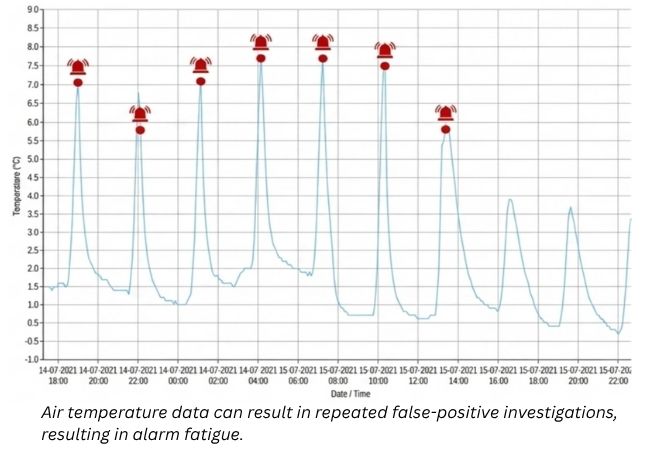
However, air temperature sensors react almost instantly to these changes. A brief door opening or defrost cycle can cause a rapid spike in air temperature, even though the stored product remains stable. This creates what engineers often refer to as ‘data noise’.
The Consequence: False Alarms and Alert Fatigue
When monitoring systems rely solely on air temperature, this ‘noise’ becomes problematic. Short-term spikes can trigger alarms that do not reflect real risk. Over time, this leads to frequent nuisance alerts or time wasted investigating non-issues. They can also cause desensitisation among staff and increased risk of missing genuine failures.
The concept of alarm fatigue is well documented in healthcare1 and industrial2 environments. Studies in clinical settings have shown that excessive non-actionable alarms can reduce response rates and compromise safety outcomes. The consequences are not just the risk of inefficiencies, but this can also be operationally dangerous.
The Core Insight: Products Change Temperature Slowly
To understand the solution, we need to consider a key principle of thermodynamics – products do not respond to temperature changes as quickly as air does. This is due to thermal inertia3. Air has low thermal mass, meaning it heats and cools rapidly. By contrast, products such as food, liquids, or pharmaceuticals have significantly higher thermal mass. They absorb and release heat slowly.
For example, a refrigerator may briefly reach 10°C during a defrost cycle, but the product inside may remain safely within acceptable limits. This difference is important, as monitoring air temperature alone provides an incomplete and often misleading picture of product safety.
Product Simulation Technology
Product simulation technology addresses this gap by shifting the focus from air temperature to estimated product temperature. Rather than measuring the product directly, these systems use algorithms to simulate how a product would respond to environmental changes.
At the core of this approach is a well-established scientific principle: Newton’s Law of Cooling. This law states that the rate at which an object changes temperature is proportional to the difference between its own temperature and the surrounding environment.
This relationship can be expressed as:
The greater the difference between air and product temperature, the faster the change.
As the product temperature approaches the air temperature, the rate of change slows.
Using this principle, simulation algorithms apply a damping formula to air temperature data. This effectively filters out rapid fluctuations and models the slower, more realistic response of the product.
Filtering Out the Noise
The result is a transformed data stream. Instead of reacting to every spike, the system produces a smoothed temperature profile that reflects the true condition of stored goods.
This has several important implications:
Ignoring transient air spikes. Short-lived fluctuations caused by:
Door openings
Compressor cycles
Defrost events
These are effectively filtered out. These events may cause sharp peaks in air temperature graphs, but they have minimal impact on product temperature. Simulation ensures they do not distort the data.
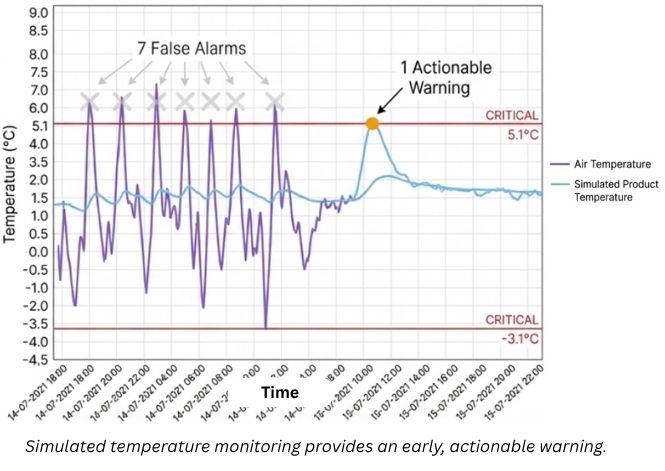
Reducing false positives: By removing volatile air data, monitoring systems can dramatically reduce unnecessary alerts. What look like ‘critical’ alerts triggered by air temperature are removed, leaving only meaningful warnings regarding product temperature when simulation is applied. This highlights a fundamental advantage: fewer alerts, but higher relevance.
Reflecting true product behaviour: Simulation provides a temperature curve that mirrors how real products behave. Analysis and studies have shown strong correlation between4:
This is significant because buffered probes have long been considered a gold standard in regulated industries.
Eliminating the need for physical probing: Traditionally, organisations have used physical probes inserted into products or placed in glycol solutions to approximate product temperature. While effective, these methods are intrusive, require manual setup, and add cost and complexity. Simulation offers a software-based alternative that achieves similar outcomes without physically touching the stock.
From Reactive to Proactive Monitoring
One of the most important benefits of product simulation is the shift from reactive to proactive monitoring. Because simulated product temperature changes more gradually, it provides a clearer signal of genuine risk. In failure scenarios, simulation can:
Detect sustained temperature rises
Trigger alerts earlier in the risk window
Provide time for corrective action
Simulated temperature monitoring will closely track the actual product and provide an early warning before critical thresholds are reached. This aligns with broader industry trends toward predictive and risk-based monitoring, particularly in pharmaceutical cold chain management.
Why This Matters for Compliance and Risk Management
Regulatory frameworks across food and healthcare sectors emphasise the importance of maintaining product integrity, not just environmental conditions.
For example:
HACCP principles focus on controlling risks to the product5
GDP guidelines stress the importance of maintaining product quality throughout storage and distribution6
Monitoring air temperature alone does not fully satisfy this requirement. Product simulation, by contrast, aligns more closely with the intent of these frameworks. It provides a measurement that reflects what truly matters: the condition of the product itself.
Capture Meaningful Data
Temperature monitoring should be less about capturing the fastest-changing data and more focused on capturing the most meaningful data. Air temperature is volatile, noisy, and often misleading. Product temperature is stable, relevant, and critical to safety. By applying scientific principles, product simulation technology bridges this gap. It transforms raw environmental data into actionable insight, enabling organisations to:
Reduce false alarms
Prevent alert fatigue
Improve operational efficiency
Strengthen compliance
Protect valuable stock
This approach is essential for any temperature-sensitive environment, but particularly where precision matters and margins for error are small.
Contact Kelsius for advice and to learn more about protecting your products with automated temperature monitoring.
Meal prep company FITT Meals is responsible for creating, preparing and delivering hundreds of thousands of meals in the UAE. They use Kelsius systems throughout their production processes to protect their food and their business.
Established in 2019, the FITT Meals business was started by Founded and CEO Eoin Cantwell. The aim of the company is to help health-conscious customers with busy lifestyles to save time but not sacrifice nutrition when it comes to mealtimes. FITT Meals shops, prepares, cooks, chills and delivers delicious and nutritionally balanced meals direct to over 500,000 customers throughout the UAE.
With affordable meal plans that provide maximum nutritional value and food quality, FITT Meals needed a temperature monitoring system that removed the need for paperwork and automated monitoring for improved efficiencies. As a company that strives to innovate and to be the best at what it does, they chose Kelsius to give them the confidence that they had an automated temperature monitoring system in place that they could rely on.
FITT Meals has recently opened a new warehouse and purpose-built facility to cater for their growing demand. With a now significantly larger operation, FITT Meals trusts Kelsius to monitor all the fresh food that passes through every stage of the production process including delivery, storage and food preparation.
Founder and CEO of FITT Meals, Eoin Cantwell said, “Moving into our new facility, there always needs to be investments upfront. One of the smartest ones we’ve made is with Kelsius, which literally ensures our food safety and ensures that our temperatures are all on check. It’s all done remotely, and everything is absolutely guaranteed for us. It’s a huge comfort knowing that we have a company like Kelsius behind us, keeping our compliance and our products up to date.”
Watch the video to learn more about how FITT Meals management trusts Kelsius.