

Temperature monitoring sits at the heart of compliance, safety, and quality assurance across food, pharmaceutical, and healthcare sectors. Whether safeguarding vaccines, chilled foods, or laboratory samples, businesses rely on accurate temperature data to make critical decisions.
But there is a fundamental flaw in how temperature is often measured. Most monitoring systems track air temperature. Yet, what truly matters is the temperature of the product itself.
This distinction is not trivial. In fact, it can be the difference between false alarms and genuine risk, between wasted stock and proactive intervention. Increasingly, industry experts and researchers are recognising that product simulation technology is essential for accurate temperature monitoring.
The Problem with Air Temperature Monitoring
At first glance, measuring air temperature seems logical. It is easy to capture, quick to respond, and widely used. However, refrigeration systems do not operate in a steady, constant state. They are dynamic systems by design.
Refrigeration units operate within controlled cycles:
- Compressors switch on and off to maintain efficiency
- Internal temperatures fluctuate within a defined band
- Defrost cycles temporarily raise temperatures
- Door openings introduce short bursts of warmer air
These behaviours create natural temperature oscillations, often ranging several degrees above and below the setpoint.
Crucially, these fluctuations are:
- Normal
- Engineered
- Necessary for system performance and longevity
However, air temperature sensors react almost instantly to these changes. A brief door opening or defrost cycle can cause a rapid spike in air temperature, even though the stored product remains stable. This creates what engineers often refer to as ‘data noise’.
The Consequence: False Alarms and Alert Fatigue
When monitoring systems rely solely on air temperature, this ‘noise’ becomes problematic. Short-term spikes can trigger alarms that do not reflect real risk. Over time, this leads to frequent nuisance alerts or time wasted investigating non-issues. They can also cause desensitisation among staff and increased risk of missing genuine failures.
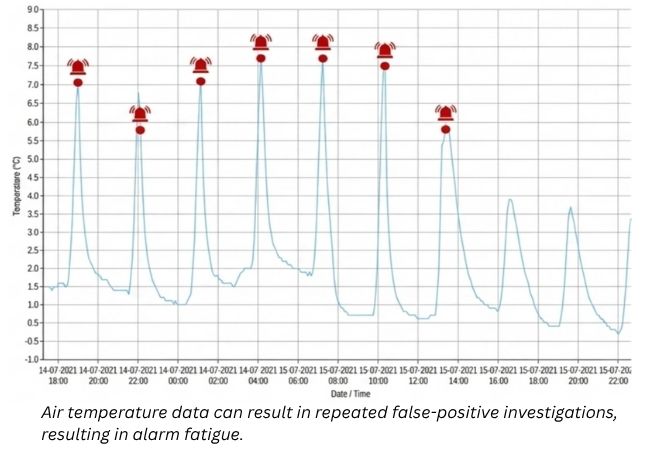
The concept of alarm fatigue is well documented in healthcare1 and industrial2 environments. Studies in clinical settings have shown that excessive non-actionable alarms can reduce response rates and compromise safety outcomes. The consequences are not just the risk of inefficiencies, but this can also be operationally dangerous.
The Core Insight: Products Change Temperature Slowly
To understand the solution, we need to consider a key principle of thermodynamics – products do not respond to temperature changes as quickly as air does. This is due to thermal inertia3. Air has low thermal mass, meaning it heats and cools rapidly. By contrast, products such as food, liquids, or pharmaceuticals have significantly higher thermal mass. They absorb and release heat slowly.
For example, a refrigerator may briefly reach 10°C during a defrost cycle, but the product inside may remain safely within acceptable limits. This difference is important, as monitoring air temperature alone provides an incomplete and often misleading picture of product safety.
Product Simulation Technology
Product simulation technology addresses this gap by shifting the focus from air temperature to estimated product temperature. Rather than measuring the product directly, these systems use algorithms to simulate how a product would respond to environmental changes.
At the core of this approach is a well-established scientific principle: Newton’s Law of Cooling. This law states that the rate at which an object changes temperature is proportional to the difference between its own temperature and the surrounding environment.
This relationship can be expressed as:
- The greater the difference between air and product temperature, the faster the change.
- As the product temperature approaches the air temperature, the rate of change slows.
Using this principle, simulation algorithms apply a damping formula to air temperature data. This effectively filters out rapid fluctuations and models the slower, more realistic response of the product.
Filtering Out the Noise
The result is a transformed data stream. Instead of reacting to every spike, the system produces a smoothed temperature profile that reflects the true condition of stored goods.
This has several important implications:
- Ignoring transient air spikes. Short-lived fluctuations caused by:
- Door openings
- Compressor cycles
- Defrost events
These are effectively filtered out. These events may cause sharp peaks in air temperature graphs, but they have minimal impact on product temperature. Simulation ensures they do not distort the data.
- Reducing false positives: By removing volatile air data, monitoring systems can dramatically reduce unnecessary alerts. What look like ‘critical’ alerts triggered by air temperature are removed, leaving only meaningful warnings regarding product temperature when simulation is applied. This highlights a fundamental advantage: fewer alerts, but higher relevance.
- Reflecting true product behaviour: Simulation provides a temperature curve that mirrors how real products behave. Analysis and studies have shown strong correlation between4:
- Simulated product temperature
- Physical buffered probes (e.g. glycol-filled vials)
This is significant because buffered probes have long been considered a gold standard in regulated industries.
- Eliminating the need for physical probing: Traditionally, organisations have used physical probes inserted into products or placed in glycol solutions to approximate product temperature. While effective, these methods are intrusive, require manual setup, and add cost and complexity. Simulation offers a software-based alternative that achieves similar outcomes without physically touching the stock.
From Reactive to Proactive Monitoring
One of the most important benefits of product simulation is the shift from reactive to proactive monitoring. Because simulated product temperature changes more gradually, it provides a clearer signal of genuine risk. In failure scenarios, simulation can:
- Detect sustained temperature rises
- Trigger alerts earlier in the risk window
- Provide time for corrective action
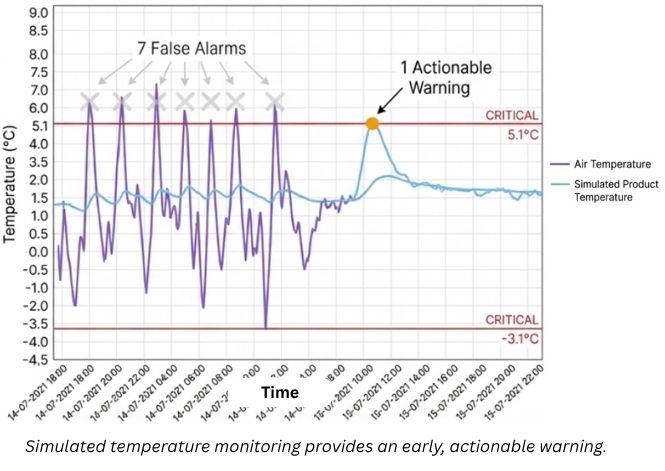
Simulated temperature monitoring will closely track the actual product and provide an early warning before critical thresholds are reached. This aligns with broader industry trends toward predictive and risk-based monitoring, particularly in pharmaceutical cold chain management.
Why This Matters for Compliance and Risk Management
Regulatory frameworks across food and healthcare sectors emphasise the importance of maintaining product integrity, not just environmental conditions.
For example:
- HACCP principles focus on controlling risks to the product5
- GDP guidelines stress the importance of maintaining product quality throughout storage and distribution6
Monitoring air temperature alone does not fully satisfy this requirement. Product simulation, by contrast, aligns more closely with the intent of these frameworks. It provides a measurement that reflects what truly matters: the condition of the product itself.
Capture Meaningful Data
Temperature monitoring should be less about capturing the fastest-changing data and more focused on capturing the most meaningful data. Air temperature is volatile, noisy, and often misleading. Product temperature is stable, relevant, and critical to safety. By applying scientific principles, product simulation technology bridges this gap. It transforms raw environmental data into actionable insight, enabling organisations to:
- Reduce false alarms
- Prevent alert fatigue
- Improve operational efficiency
- Strengthen compliance
- Protect valuable stock
This approach is essential for any temperature-sensitive environment, but particularly where precision matters and margins for error are small.
Contact Kelsius for advice and to learn more about protecting your products with automated temperature monitoring.
Sources:
- Joint Commission, ‘National Patient Safety Goal on Alarm Management’ https://www.jointcommission.org/standards/national-patient-safety-goals/
- Health and Safety Executive (UK), ‘Better Alarm Handling’, https://www.hse.gov.uk/pubns/chis6.pdf
- Science Direct, definition ‘Thermal Inertia’, https://www.sciencedirect.com/topics/engineering/thermal-inertia
- National Institute of Standards and Technology (NIST), ‘Cold Chain Management: Temperature Monitoring Solutions’, https://www.nist.gov/system/files/documents/2017/04/28/NIC45-Cold-Chain-Management-Temperature-Monitoring-Solutions.pdf
- Food Standards Agency, ‘Hazard Analysis and Critical Control Point (HACCP), https://www.food.gov.uk/business-guidance/hazard-analysis-and-critical-control-point-haccp
- European Medicines Agency, ‘Good Distribution Practice’, https://www.ema.europa.eu/en/human-regulatory-overview/post-authorisation/compliance-post-authorisation/good-distribution-practice