
Kelsius is proud to continue its association with National Craft Butchers (NCB) and its members as a sponsor of the upcoming NCB Product Awards 2026.
The NCB Product Awards are an opportunity to showcase the craft butchery industry. They recognise the businesses and teams that go above and beyond to create exceptional products, consistent quality and fresh innovation. From traditional favourites to new product ideas, the awards highlight the talent and dedication that make independent butchers such an important part of local communities.
This year, Kelsius is delighted to sponsor the Hot Eating Pie category, supporting one of the standout product areas in craft butchery and celebrating the skill, creativity and quality that butchers across the UK bring to their counters every day.
For Kelsius, supporting the awards is a natural extension of its work with butchers and food businesses. Kelsius helps butchers manage food safety, compliance and daily checks with greater confidence through its digital HACCP and automated temperature monitoring solutions. Kelsius is proud to work alongside businesses that put quality, safety and customer trust at the centre of everything they do.
Speaking about the awards, Keith Burke, Sales Manager for Butchery & Food Manufacturing at Kelsius, said, “Kelsius has built a strong relationship with National Craft Butchers over the years, and we are always delighted to support the organisation and its members. Craft butchers are passionate about quality, consistency and customer service, and we are proud to help them manage food safety and compliance in a practical, reliable way. The NCB Product Awards are a brilliant opportunity to celebrate the skills and innovation within the industry. I’m really looking forward to seeing the products that this year’s competition produces.”
The 2026 awards include a wide range of categories, giving craft butchers the opportunity to showcase the very best of their product range. Categories include Hot Eating Pie, Cold Eating Pie, Traditional Sausage, Innovative Sausage, Traditional Bacon, Innovative Bacon, Traditional Black Pudding, Best 30-Minute Meal, and Best Game Product.
Additional new categories for 2026 include Best Delicatessen Meats and Charcuterie, Best BBQ Product, and Best Delicatessen Product.
Recognition at the NCB Product Awards can help build customer confidence and give teams well-earned recognition. It is also a valuable opportunity for butchers to benchmark their products and celebrate the hard work that goes into producing high-quality food every day.
Entries are now open and close on Monday 17 August 2026 or earlier if categories reach capacity. So butchers are encouraged to submit their entries as soon as possible with the NCB here.
Judging will take place on Friday 4 September 2026 at Harper Adams University, where products will be assessed through blind tasting by an experienced panel of industry experts. Winners will be announced in October.
Kelsius wishes all entrants the very best of luck and looks forward to celebrating the businesses helping to shape the future of craft butchery.
Contact Kelsius to learn more about automated temperature monitoring for butchers with real-time alerts.
In recent years Europe is repeatedly experiencing summer heatwaves, with June heatwaves becoming increasingly common particularly in Spain. Spain’s state weather service, Aemet, reports 10 recorded heatwaves in June in mainland Spain between 2000 and 2025, and just two in the previous 25 years1.
Other countries are similarly experiencing hotter temperatures and more frequent heatwaves. As well as the impact this has on the lives and health of people, high temperatures can also affect the safety of temperature-sensitive products.
When temperatures rise, fridges and freezers become even more critical to food safety, product quality and compliance. For food businesses, healthcare sites, laboratories, pharmacies, hospitality operators and cold-chain teams, unusually hot weather can place refrigeration equipment under additional pressure. The unit may still appear to be running normally, but behind the scenes the system is often working harder to maintain the required temperature.
This matters because chilled and frozen products rely on stable storage conditions. If a fridge or freezer can’t remove heat quickly enough, internal temperatures can rise. Even short periods outside the correct temperature range can increase food safety risk, affect product quality, reduce shelf life or create compliance issues.
Understanding how refrigeration systems operate, and why hot weather can make their job more difficult, helps businesses prepare before problems occur.
How fridges and freezers normally work
Most commercial fridges and freezers operate using a vapour compression refrigeration cycle. While the equipment can vary in size, from an upright fridge to a walk-in freezer or cold room, the basic principle is the same.
The purpose of the system is to remove heat from inside the cabinet, room or storage area and release that heat outside the cooled space. It does not “create cold” in the way many people imagine. Instead, it continuously moves heat from one place to another.
The main components involved are:
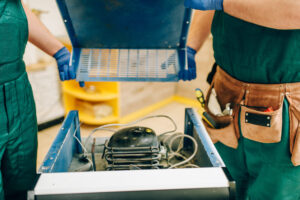
The evaporator: This sits inside the cooled area. Refrigerant passes through the evaporator at a low temperature and absorbs heat from the air inside the fridge or freezer.
The compressor: The compressor pumps refrigerant around the system. It raises the pressure and temperature of the refrigerant so that the absorbed heat can be released.
The condenser: The condenser is usually located outside the chilled space, often at the back, top or external plant area of the unit. Its job is to reject heat into the surrounding air.
The expansion valve or metering device: This controls the flow of refrigerant into the evaporator and reduces its pressure, allowing it to absorb heat again.
Fans and controls: Fans move air across the evaporator and condenser coils. Sensors and thermostats monitor temperature and tell the system when to switch on, run harder or switch off.
During normal operation, the thermostat detects when the internal temperature rises above the set point. The compressor starts, refrigerant circulates and the system removes heat until the required temperature is reached again. The compressor then cycles off or reduces output, depending on the type of system.
In a well-maintained unit, this process happens continuously throughout the day. Doors open, warm air enters, products are loaded, and the system responds by removing the extra heat.
What changes during extremely hot weather?
During hot weather, the fridge or freezer still works in the same technical way. The refrigeration cycle does not change. However, the conditions around the equipment change significantly.
A fridge that performs adequately in mild conditions may struggle when temperatures rise.
The most important factor is the difference between the temperature inside the unit and the temperature outside it. A fridge may be trying to hold food at around 5°C or below, while the surrounding room might be 28°C or higher. A freezer may be trying to maintain frozen products at around -18°C while rejecting heat into very warm ambient air.
This wider temperature difference creates a higher heat load. More heat enters the cabinet through door openings, walls, seals and product loading. At the same time, the condenser has to reject heat into air that’s already warm. That makes the process less efficient.
In practical terms, the system may need to run for longer periods. The compressor may cycle on more frequently. Fans may operate more often. Defrost cycles may become more important. Any weakness in the equipment, such as dirty condenser coils, worn door seals, poor airflow or low refrigerant charge, can become more noticeable during hot weather.
A fridge or freezer that performs adequately in mild conditions may struggle when temperatures rise.
The compressor works harder
The compressor is one of the hardest-working parts of a refrigeration system. During hot weather, it may be under increased pressure because the system needs to remove more heat and run for longer.
When the condenser is exposed to high ambient temperatures, the refrigerant may not reject heat as easily. This can increase the pressure on the high side of the system. The compressor then has to work harder to move refrigerant and maintain the required cooling effect.
Longer run times can increase wear. Higher operating pressures can increase stress. Electrical components may also run hotter. If the compressor is already ageing, poorly maintained or operating in a poorly ventilated area, unusually hot weather can increase the likelihood of failure.
This does not mean that every fridge or freezer will break down during a heatwave. Well-designed, well-maintained equipment should be able to cope with expected operating conditions. However, hot weather reduces the margin for error. It can expose problems that were previously hidden.
The condenser has to reject heat into hotter air
The condenser is responsible for releasing heat from the refrigeration system into the surrounding environment. It works best when there is good airflow and a reasonable difference between the condenser temperature and the surrounding air temperature.
During extremely hot weather, this becomes more difficult. The air around the condenser is warmer, so heat transfer is less effective. If the condenser coil is dusty, blocked or located in a cramped plant room, the problem can become worse.
Poor condenser performance can lead to higher head pressure, longer compressor run times and reduced cooling capacity. In some cases, the system may trip on high pressure to protect itself. This can leave the fridge, freezer or cold room unable to maintain temperature until the fault is resolved.
For this reason, condenser cleaning and ventilation are particularly important before and during periods of hot weather.
Door seals, insulation and airflow become more important
Hot weather also increases the importance of the basic physical condition of the unit.
Door seals help prevent warm air entering the fridge or freezer. If seals are cracked, loose or damaged, warm air can leak into the cabinet. This forces the system to remove more heat and may lead to condensation, ice build-up or unstable internal temperatures.
Insulation also plays a key role. The walls, doors and panels of the unit are designed to slow heat transfer. If insulation is damaged or panels are poorly fitted, more heat enters the cooled space.
Airflow inside the unit is another important factor. If stock is packed too tightly or vents are blocked, cold air cannot circulate properly. This can create warm spots, even if the temperature sensor shows that part of the unit is within range. During hot weather, poor airflow can become a bigger issue because the system has less spare cooling capacity.
Fans and evaporators may be under more pressure
Evaporator fans circulate cold air around the storage area. Condenser fans help remove heat from the system. During hot weather, both may run more frequently or for longer periods.
If a fan motor is weak, obstructed or failing, the refrigeration system may not perform properly. Reduced airflow across the evaporator can affect cooling inside the cabinet. Reduced airflow across the condenser can prevent heat from being rejected effectively.
The evaporator itself can also be affected by moisture. When warm, humid air enters a fridge or freezer, especially through frequent door openings, moisture can condense or freeze on the evaporator coil. In freezers, this can contribute to ice build-up. Excessive frost can restrict airflow and reduce the system’s ability to absorb heat.
Defrost systems are designed to manage this, but if defrost cycles are not working correctly, hot weather and high humidity can make the issue more visible.
Are fridges and freezers more likely to break down in hot weather?
It’s possible, especially if they are already under-maintained, overloaded or operating in poor conditions.
Hot weather does not automatically cause refrigeration failure. Commercial units are designed to operate within specified ambient temperature ranges. However, when ambient temperature rises, the system has to work harder. Components may experience longer run times, higher pressures and greater thermal stress.
Problems that may be manageable in cooler weather can become critical in hot weather. Examples include:
Dirty condenser coils
Blocked airflow around the unit
Damaged door seals
Poorly closing doors
Overloaded cabinets
Frequent door openings
Faulty fans
Incorrect thermostat settings
Low refrigerant charge
Ageing compressors
Poorly maintained defrost systems
The risk isn’t just that a unit stops working completely. A more common issue is that it slowly struggles to maintain temperature. This can be harder to spot without continuous monitoring because the unit may still sound as if it is running.
The risk to chilled and frozen products
Higher temperatures can allow harmful bacteria to grow more quickly around temperature-sensitive food in storage.
When fridges and freezers struggle, product temperature can rise. This creates several risks.
For chilled food, higher temperatures can allow harmful bacteria to grow more quickly2. Even where food remains visually unchanged, the safety risk may increase if it has been held outside the required temperature range.
For frozen food, temperature rise can affect quality and safety. Partial thawing and refreezing can damage texture, increase ice crystal formation and reduce product integrity. In some cases, frozen products may no longer be suitable for sale or use.
For healthcare, pharmacy, laboratory and life sciences environments, the stakes can be just as significant. Medicines, vaccines, samples, reagents and other temperature-sensitive materials may have strict storage requirements. A temperature excursion can compromise product stability, create documentation challenges and lead to costly wastage.
In any regulated environment, the issue is not only whether a product feels cold or frozen. The question is whether it has remained within the approved temperature range for the required period.
Why manual checks may not be enough
During hot weather, temperature can change quickly. A manual check carried out once or twice a day may miss an overnight excursion, a lunchtime door issue or a gradual rise caused by a failing component.
By the time a member of staff notices a problem, the unit may already have been outside range for several hours. Without a clear temperature record, it can be difficult to know when the issue started, how long products were affected and what has been happening at each CCP3.
Continuous temperature monitoring gives teams better visibility. Automated alerts can warn staff when temperatures move outside agreed limits, allowing them to act before stock, samples or medicines are compromised. Digital records also support audit readiness by showing the temperature history and the response taken.
Practical steps during hot weather
Businesses can reduce risk by preparing refrigeration equipment before hot weather arrives and increasing vigilance during warm periods.
Key actions include:
Check that fridges, freezers and cold rooms are operating at the correct set temperatures4
Inspect door seals and replace damaged seals promptly
Avoid overloading cabinets or blocking vents
Minimise unnecessary door openings
Allow hot food or deliveries to cool appropriately before loading, where safe and suitable
Check that fans are operating correctly
Review defrost performance on freezers
Ensure condenser and evaporator coils are inspected and cleaned as part of routine refrigeration maintenance, and check that airflow around the equipment is not restricted5
Keep plant rooms and back-of-house areas as cool and ventilated as possible
Use automated monitoring and alerts to detect issues early
Record corrective actions when temperatures move outside limits
Hot weather makes monitoring essential
Extremely hot weather places additional pressure on fridges and freezers. The refrigeration cycle remains the same, but units must work harder to remove heat and maintain safe storage conditions. Compressors, condensers, fans, seals, evaporators and defrost systems all become more important when ambient temperatures rise.
Ensure that monitoring processes and systems are in place to alert staff if equipment is struggling or fails, potentially leading to products moving outside safe or approved temperature ranges. Wastage, compliance issues, product degradation and financial loss can all be the result of equipment failure, which could otherwise be averted if reliable monitoring is in place.
Contact Kelsius to learn more about automated temperature monitoring with real-time alerts.
Temperature monitoring sits at the heart of compliance, safety, and quality assurance across food, pharmaceutical, and healthcare sectors. Whether safeguarding vaccines, chilled foods, or laboratory samples, businesses rely on accurate temperature data to make critical decisions.
But there is a fundamental flaw in how temperature is often measured. Most monitoring systems track air temperature. Yet, what truly matters is the temperature of the product itself.
This distinction is not trivial. In fact, it can be the difference between false alarms and genuine risk, between wasted stock and proactive intervention. Increasingly, industry experts and researchers are recognising that product simulation technology is essential for accurate temperature monitoring.
The Problem with Air Temperature Monitoring
At first glance, measuring air temperature seems logical. It is easy to capture, quick to respond, and widely used. However, refrigeration systems do not operate in a steady, constant state. They are dynamic systems by design.
Refrigeration units operate within controlled cycles:
Compressors switch on and off to maintain efficiency
Internal temperatures fluctuate within a defined band
Defrost cycles temporarily raise temperatures
Door openings introduce short bursts of warmer air
These behaviours create natural temperature oscillations, often ranging several degrees above and below the setpoint.
Crucially, these fluctuations are:
Normal
Engineered
Necessary for system performance and longevity
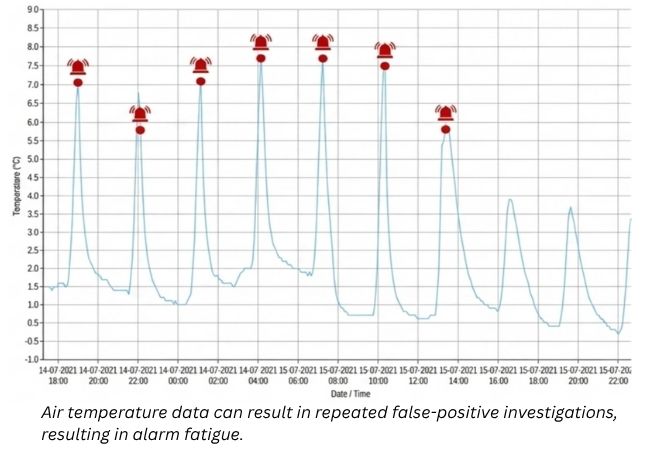
However, air temperature sensors react almost instantly to these changes. A brief door opening or defrost cycle can cause a rapid spike in air temperature, even though the stored product remains stable. This creates what engineers often refer to as ‘data noise’.
The Consequence: False Alarms and Alert Fatigue
When monitoring systems rely solely on air temperature, this ‘noise’ becomes problematic. Short-term spikes can trigger alarms that do not reflect real risk. Over time, this leads to frequent nuisance alerts or time wasted investigating non-issues. They can also cause desensitisation among staff and increased risk of missing genuine failures.
The concept of alarm fatigue is well documented in healthcare1 and industrial2 environments. Studies in clinical settings have shown that excessive non-actionable alarms can reduce response rates and compromise safety outcomes. The consequences are not just the risk of inefficiencies, but this can also be operationally dangerous.
The Core Insight: Products Change Temperature Slowly
To understand the solution, we need to consider a key principle of thermodynamics – products do not respond to temperature changes as quickly as air does. This is due to thermal inertia3. Air has low thermal mass, meaning it heats and cools rapidly. By contrast, products such as food, liquids, or pharmaceuticals have significantly higher thermal mass. They absorb and release heat slowly.
For example, a refrigerator may briefly reach 10°C during a defrost cycle, but the product inside may remain safely within acceptable limits. This difference is important, as monitoring air temperature alone provides an incomplete and often misleading picture of product safety.
Product Simulation Technology
Product simulation technology addresses this gap by shifting the focus from air temperature to estimated product temperature. Rather than measuring the product directly, these systems use algorithms to simulate how a product would respond to environmental changes.
At the core of this approach is a well-established scientific principle: Newton’s Law of Cooling. This law states that the rate at which an object changes temperature is proportional to the difference between its own temperature and the surrounding environment.
This relationship can be expressed as:
The greater the difference between air and product temperature, the faster the change.
As the product temperature approaches the air temperature, the rate of change slows.
Using this principle, simulation algorithms apply a damping formula to air temperature data. This effectively filters out rapid fluctuations and models the slower, more realistic response of the product.
Filtering Out the Noise
The result is a transformed data stream. Instead of reacting to every spike, the system produces a smoothed temperature profile that reflects the true condition of stored goods.
This has several important implications:
Ignoring transient air spikes. Short-lived fluctuations caused by:
Door openings
Compressor cycles
Defrost events
These are effectively filtered out. These events may cause sharp peaks in air temperature graphs, but they have minimal impact on product temperature. Simulation ensures they do not distort the data.
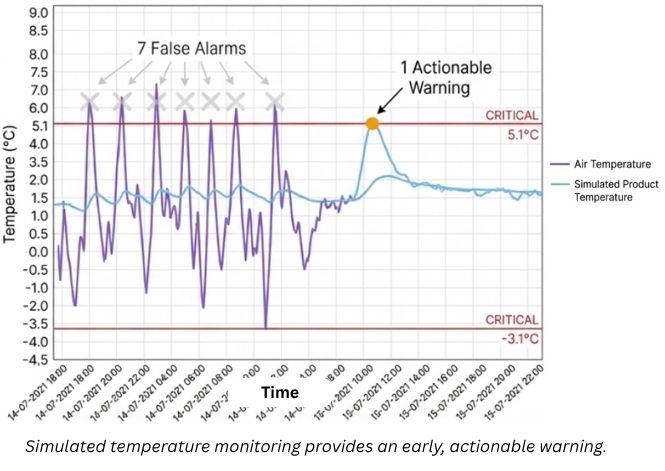
Reducing false positives: By removing volatile air data, monitoring systems can dramatically reduce unnecessary alerts. What look like ‘critical’ alerts triggered by air temperature are removed, leaving only meaningful warnings regarding product temperature when simulation is applied. This highlights a fundamental advantage: fewer alerts, but higher relevance.
Reflecting true product behaviour: Simulation provides a temperature curve that mirrors how real products behave. Analysis and studies have shown strong correlation between4:
This is significant because buffered probes have long been considered a gold standard in regulated industries.
Eliminating the need for physical probing: Traditionally, organisations have used physical probes inserted into products or placed in glycol solutions to approximate product temperature. While effective, these methods are intrusive, require manual setup, and add cost and complexity. Simulation offers a software-based alternative that achieves similar outcomes without physically touching the stock.
From Reactive to Proactive Monitoring
One of the most important benefits of product simulation is the shift from reactive to proactive monitoring. Because simulated product temperature changes more gradually, it provides a clearer signal of genuine risk. In failure scenarios, simulation can:
Detect sustained temperature rises
Trigger alerts earlier in the risk window
Provide time for corrective action
Simulated temperature monitoring will closely track the actual product and provide an early warning before critical thresholds are reached. This aligns with broader industry trends toward predictive and risk-based monitoring, particularly in pharmaceutical cold chain management.
Why This Matters for Compliance and Risk Management
Regulatory frameworks across food and healthcare sectors emphasise the importance of maintaining product integrity, not just environmental conditions.
For example:
HACCP principles focus on controlling risks to the product5
GDP guidelines stress the importance of maintaining product quality throughout storage and distribution6
Monitoring air temperature alone does not fully satisfy this requirement. Product simulation, by contrast, aligns more closely with the intent of these frameworks. It provides a measurement that reflects what truly matters: the condition of the product itself.
Capture Meaningful Data
Temperature monitoring should be less about capturing the fastest-changing data and more focused on capturing the most meaningful data. Air temperature is volatile, noisy, and often misleading. Product temperature is stable, relevant, and critical to safety. By applying scientific principles, product simulation technology bridges this gap. It transforms raw environmental data into actionable insight, enabling organisations to:
Reduce false alarms
Prevent alert fatigue
Improve operational efficiency
Strengthen compliance
Protect valuable stock
This approach is essential for any temperature-sensitive environment, but particularly where precision matters and margins for error are small.
Contact Kelsius for advice and to learn more about protecting your products with automated temperature monitoring.
Meal prep company FITT Meals is responsible for creating, preparing and delivering hundreds of thousands of meals in the UAE. They use Kelsius systems throughout their production processes to protect their food and their business.
Established in 2019, the FITT Meals business was started by Founded and CEO Eoin Cantwell. The aim of the company is to help health-conscious customers with busy lifestyles to save time but not sacrifice nutrition when it comes to mealtimes. FITT Meals shops, prepares, cooks, chills and delivers delicious and nutritionally balanced meals direct to over 500,000 customers throughout the UAE.
With affordable meal plans that provide maximum nutritional value and food quality, FITT Meals needed a temperature monitoring system that removed the need for paperwork and automated monitoring for improved efficiencies. As a company that strives to innovate and to be the best at what it does, they chose Kelsius to give them the confidence that they had an automated temperature monitoring system in place that they could rely on.
FITT Meals has recently opened a new warehouse and purpose-built facility to cater for their growing demand. With a now significantly larger operation, FITT Meals trusts Kelsius to monitor all the fresh food that passes through every stage of the production process including delivery, storage and food preparation.
Founder and CEO of FITT Meals, Eoin Cantwell said, “Moving into our new facility, there always needs to be investments upfront. One of the smartest ones we’ve made is with Kelsius, which literally ensures our food safety and ensures that our temperatures are all on check. It’s all done remotely, and everything is absolutely guaranteed for us. It’s a huge comfort knowing that we have a company like Kelsius behind us, keeping our compliance and our products up to date.”
Watch the video to learn more about how FITT Meals management trusts Kelsius.
Conference Aston is Birmingham’s only residential conference centre, located on the Aston University campus. The venue operates a single kitchen serving hotel guests, delegates and private events. With a focus on delivering high-quality, safe catering experiences, Conference Aston combines hospitality excellence with modern operational management.
Managing food safety across a large hospitality venue with a single kitchen was becoming increasingly complex. Conference Aston relied on paper-based HACCP records, which could be time-consuming, inconsistent and prone to human error or falsification. Chefs used to spend hours photocopying and filing paperwork.
Audits could be slow with record-keeping traceability time-consuming to trace when issues arose. The leadership recognised the need for a modern, digital solution to standardise checks, ensure accuracy, and provide instant access to compliance data across all catering operations.
With the introduction of FoodCheck 2.0 from Kelsius, the Executive Head Chef has been able to tailor the system’s tasks and workflows to match existing operations, adding checks for deliveries, cleaning, and equipment monitoring. The platform’s flexibility allows new tasks, users and schedules to be added instantly, ensuring the system always reflects current operational needs.
Conference Aston and Wilson Vale have transformed their food safety culture by moving from paper to a fully digital, automated process. The team now saves five hours each week, operates more sustainably, and has complete confidence in compliance and traceability. The Kelsius FoodCheck 2.0 system has become integral to daily operations, helping Conference Aston deliver the highest standards of food safety, quality and guest assurance.
In today’s global supply chains, moving temperature-sensitive products – from fresh produce to medicines – is both a logistical necessity and a growing challenge. With rising demand for perishable food products, increased healthcare transportation requirements, and stricter regulatory standards, precise temperature control must be maintained throughout transportation. Failure to do so carries not just financial risk but also public health consequences.
The recent launch by Kelsius of FoodTrak365 and CoolTrak365 underscores a fundamental shift: businesses must adopt automated, real-time temperature monitoring solutions to protect products, ensure compliance, and minimise waste.
This article explores why automating temperature monitoring in transit matters more than ever. We look at economic losses from temperature excursions, examples of cold chain failures caused by manual error or unexpected events, and the scale of temperature-controlled transport markets that depend on real-time visibility.
The Scale of Temperature-Sensitive Transport
Temperature-controlled logistics, often referred to as the cold chain, is a significant and rapidly expanding segment of global supply chains.
The global cold chain logistics market was valued at around USD393.2 billion in 2025 and is forecast to grow to approximately USD1,632.6 billion by 2035, expanding more than fourfold in just a decade. This growth reflects rising consumer demand for fresh food year-round and the expanding distribution of temperature-sensitive pharmaceuticals and biological products. Transportation services alone are expected to account for nearly 45% of cold chain logistics demand by 2025.1
More locally, the UK and Europe are experiencing similar trends: up to 30% of all food produced in Europe requires cold chain logistics due to perishability and quality standards.2
In short, billions of dollars’ worth of goods are in motion every day that require tight temperature controls, and transportation is the most vulnerable segment of that journey.
How Much Product Is Lost Without Reliable Temperature Control?
The cost of temperature excursions is already affecting businesses on a massive scale.
A key finding from international health authorities is that up to 50% of vaccines are wasted globally each year because of inadequate temperature control, logistics, and shipment issues.3 This staggering loss represents billions in product value, compromised public health outcomes, and wasted human effort.
Across broader cold chains, it is estimated that temperature-control failures contribute to roughly 526 million tonnes of food lost annually, equivalent to nearly 13% of all food produced worldwide. When accounting for disposal, logistics, compliance breaches, and opportunity costs, this loss is estimated at a value approaching USD1 trillion every year.4
In the pharmaceutical sector, cold chain failures can affect the journey at any stage, with the most common issues arising due to temperature fluctuations, exposure to extreme environmental conditions, delayed transport, and handling errors. It is estimated that 12% of pharmaceutical shipments experience temperature excursions.5 Even minor excursions of just a few degrees can degrade products such as monoclonal antibodies, insulin, and mRNA-based vaccines, rendering them unsafe or ineffective.
These figures show that temperature instability is one of the most wasteful weaknesses in current logistics systems.
Real-World Costs of Manual Error and Oversights
Cold chain systems are complex, involving multiple handovers, storage environments, and shifting external conditions. Each transition point – loading docks, vehicle transfers, unloading at destination – introduces risk.
Human error alone is a frequent contributor to cold chain failures. A study by the Georgia Institute of Technology estimated that up to 90% of such failures resulted from human error.6
Lapses such as these and related issues lead to costly spoilage events:
The pharmaceutical industry loses approximately USD35 billion in products per year because of failures in temperature-controlled logistics – the vast majority of which are preventable.7
In food logistics, breaks in the cold chain – from simple temperature fluctuations to prolonged exposure outside optimal ranges – are a major contributor to global food loss and waste, particularly for perishable goods such as dairy, meat, fruits and vegetables.8
Weather-related transit delays, refrigeration unit failures, or oversight during customs processing have also been directly linked to cold chain breaches that resulted in waste and regulatory non-compliance.5
Across industries, these incidents demonstrate that temperature checks and retrospective documentation can record damage that occurs but not prevent it.
Why Automation and Real-Time Monitoring Matters
Automated temperature monitoring transforms logistics from reactive to proactive. Instead of waiting for inspections or manual log entries at checkpoints, connected sensors offer continuous, real-time data throughout the transport lifecycle.
This capability has several crucial benefits:
Immediate Alerts: Automated systems notify logistics teams instantly when temperatures deviate, allowing corrective action before products are compromised.
Audit Trail for Compliance: Digital records provide tamper-proof documentation for regulators and quality auditors in food safety (HACCP) and healthcare (GDP) environments.
Reduced Human Error: By removing manual logging, automated systems reduce the risk of inaccurate entries, missed checks, or unreported excursions.
Enhanced Visibility: Integrated dashboards often allow end-to-end tracking, giving stakeholders visibility into every stage of the supply chain.
Predictive Insights: Over time, data from temperature monitoring can reveal patterns, enabling companies to refine routes, optimise refrigeration, and prevent recurring issues.
Automated Monitoring in Practice: Food and Healthcare Logistics
In food logistics, products like fresh produce, dairy, and prepared meals are highly sensitive to temperature swings. Even brief excursions can accelerate spoilage, deteriorate quality, and promote bacterial growth. Automated tracking helps ensure these goods remain in specified temperature ranges until they reach retail shelves or restaurant kitchens.
In medical logistics, vaccines and biological products often require ultra-precise temperature ranges – some as low as -70°C for mRNA vaccines – to maintain efficacy. Vaccines are particularly delicate biological substances that will have reduced or lost efficacy if they are frozen, if stored above +8°C, or if exposed to direct sunlight or ultraviolet light (UV).9
Across both sectors, the margin for error is shrinking as products become more specialised and regulations more stringent.
Temperature Monitoring that meets consumers’ demands and regulators’ standards
The sheer volume and value of temperature-controlled goods in global transport illustrate a critical truth: maintaining temperature integrity in transit is central to modern supply chains. With up to half of all vaccines wasted, hundreds of millions of tonnes of food lost, and billions of dollars in global economic impact, the risks of cold chain failure are too high to ignore.
Automated temperature monitoring solutions like FoodTrak365 and CoolTrak365 are not just technological upgrades, they are strategic necessities for businesses that handle temperature-sensitive products. By delivering real-time visibility, reducing risk, and strengthening compliance, these systems directly address the root causes of product loss and supply chain inefficiency.
In a world where supply chains are complex, consumers demand quality and regulators expect accountability, automation is the best defence against waste, loss, and reputational risk in temperature-sensitive transport.
Contact Kelsius today to find out more about the automated temperature monitoring solution that works best for your goods in transit.
UNEP and FAO. 2022, ‘Sustainable Food Cold Chains: Opportunities, Challenges and the Way Forward’. Nairobi, UNEP and Rome, FAO. https://doi.org/10.4060/cc0923en
On average, each property saves three hours per day for all food staff
Hastings Hotels is a luxury hotel group operating six hotels and a stand-alone Gastro Pub, Cultra Inn, situated on the Culloden Estate in Northern Ireland, serving a wide range of prepared and fresh food to its customers. These seven properties offer guests an impressive choice of venues, catering across leisure, events, sporting pursuits and gourmet dining.
Challenges Faced by Management and Chefs
Hastings Hotels faced the challenge of managing food safety and HACCP records across multiple locations. Larger properties like the Grand Central and Europa Hotels have different areas for multiple kitchens, bars, delis and large catering spaces, all requiring up to date records to be kept.
Management had little oversight of all food safety records, with a paper process that was prone to errors, and too much time was spent on recording data rather than providing the best guest experience.
Chefs spent too much time reviewing paper records and manually recoding temperatures across different kitchens and floors. Stock was being lost due to no notifications of faulty appliances, and there was little traceability for food.
Introducing the Kelsius System
The Kelsius FoodCheck 2.0 system was introduced into operations at Hastings Hotels. With the system now in use in their properties, management has more confidence and peace of mind as audits and inspections are easier. Reporting is streamlined and it’s much easier to train any agency staff who are required ad hoc.
Digital traceability means better transparency and accountability, with no risk of falsification or mistakes due to human error. Automated alerts have hugely reduced the risk of food waste due to temperature excursions, improving the shelf life of products.
Benefits
Three hours saved per day on average per property by all food staff
Estimated £2000 per year per property saved on wasted food
Four hours per week saved by management using automated report
Paper, ink and folders used reduce to zero
Food safety training time reduced by half
90% estimated reduction in mistakes caused by human error
Raymond Duncan Compliance, Operations & Procurement Manager, Hastings Group:
“Using the Kelsius system, I have peace of mind knowing all food safety processes are being adhered to. The automated system minimises human error and it’s so much easier for management to remotely identify trends or gaps in any hotel and act in real time. Our EHO loves the system as it gives them full visibility of our processes, in turn they are more confident in us to maintain outstanding food safety for our guests. We’re delighted with the system.”