
In today’s global supply chains, moving temperature-sensitive products – from fresh produce to medicines – is both a logistical necessity and a growing challenge. With rising demand for perishable food products, increased healthcare transportation requirements, and stricter regulatory standards, precise temperature control must be maintained throughout transportation. Failure to do so carries not just financial risk but also public health consequences.
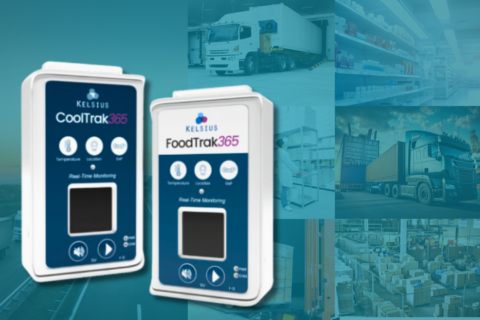
The recent launch by Kelsius of FoodTrak365 and CoolTrak365 underscores a fundamental shift: businesses must adopt automated, real-time temperature monitoring solutions to protect products, ensure compliance, and minimise waste.
This article explores why automating temperature monitoring in transit matters more than ever. We look at economic losses from temperature excursions, examples of cold chain failures caused by manual error or unexpected events, and the scale of temperature-controlled transport markets that depend on real-time visibility.
The Scale of Temperature-Sensitive Transport
Temperature-controlled logistics, often referred to as the cold chain, is a significant and rapidly expanding segment of global supply chains.
The global cold chain logistics market was valued at around USD393.2 billion in 2025 and is forecast to grow to approximately USD1,632.6 billion by 2035, expanding more than fourfold in just a decade. This growth reflects rising consumer demand for fresh food year-round and the expanding distribution of temperature-sensitive pharmaceuticals and biological products. Transportation services alone are expected to account for nearly 45% of cold chain logistics demand by 2025.1
More locally, the UK and Europe are experiencing similar trends: up to 30% of all food produced in Europe requires cold chain logistics due to perishability and quality standards.2
In short, billions of dollars’ worth of goods are in motion every day that require tight temperature controls, and transportation is the most vulnerable segment of that journey.
How Much Product Is Lost Without Reliable Temperature Control?
The cost of temperature excursions is already affecting businesses on a massive scale.
A key finding from international health authorities is that up to 50% of vaccines are wasted globally each year because of inadequate temperature control, logistics, and shipment issues.3 This staggering loss represents billions in product value, compromised public health outcomes, and wasted human effort.
Across broader cold chains, it is estimated that temperature-control failures contribute to roughly 526 million tonnes of food lost annually, equivalent to nearly 13% of all food produced worldwide. When accounting for disposal, logistics, compliance breaches, and opportunity costs, this loss is estimated at a value approaching USD1 trillion every year.4
In the pharmaceutical sector, cold chain failures can affect the journey at any stage, with the most common issues arising due to temperature fluctuations, exposure to extreme environmental conditions, delayed transport, and handling errors. It is estimated that 12% of pharmaceutical shipments experience temperature excursions.5 Even minor excursions of just a few degrees can degrade products such as monoclonal antibodies, insulin, and mRNA-based vaccines, rendering them unsafe or ineffective.
These figures show that temperature instability is one of the most wasteful weaknesses in current logistics systems.
Real-World Costs of Manual Error and Oversights
Cold chain systems are complex, involving multiple handovers, storage environments, and shifting external conditions. Each transition point – loading docks, vehicle transfers, unloading at destination – introduces risk.
Human error alone is a frequent contributor to cold chain failures. A study by the Georgia Institute of Technology estimated that up to 90% of such failures resulted from human error.6
Lapses such as these and related issues lead to costly spoilage events:
- The pharmaceutical industry loses approximately USD35 billion in products per year because of failures in temperature-controlled logistics – the vast majority of which are preventable.7
- In food logistics, breaks in the cold chain – from simple temperature fluctuations to prolonged exposure outside optimal ranges – are a major contributor to global food loss and waste, particularly for perishable goods such as dairy, meat, fruits and vegetables.8
- Weather-related transit delays, refrigeration unit failures, or oversight during customs processing have also been directly linked to cold chain breaches that resulted in waste and regulatory non-compliance.5
Across industries, these incidents demonstrate that temperature checks and retrospective documentation can record damage that occurs but not prevent it.
Why Automation and Real-Time Monitoring Matters
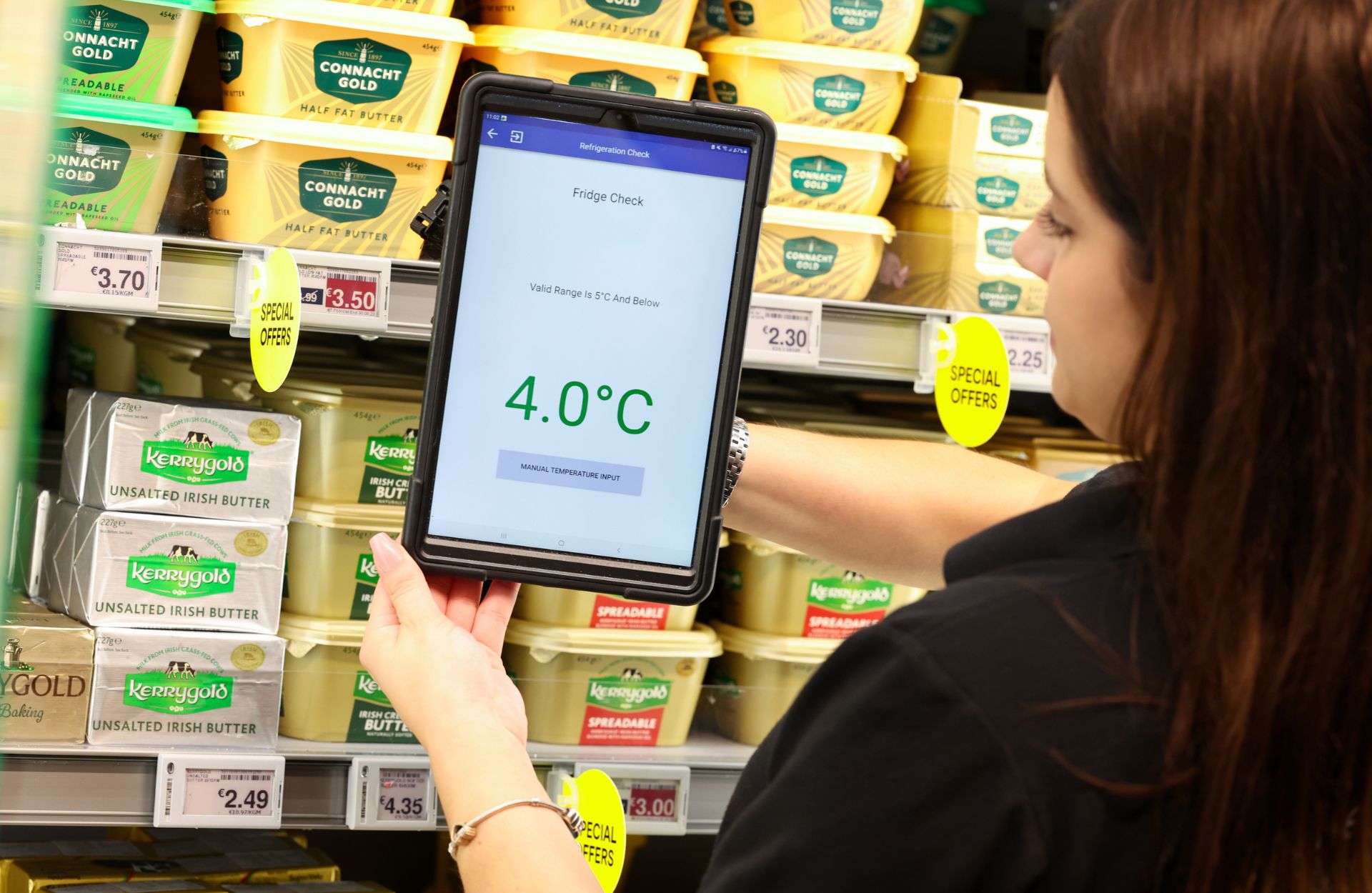
Automated temperature monitoring transforms logistics from reactive to proactive. Instead of waiting for inspections or manual log entries at checkpoints, connected sensors offer continuous, real-time data throughout the transport lifecycle.
This capability has several crucial benefits:
- Immediate Alerts: Automated systems notify logistics teams instantly when temperatures deviate, allowing corrective action before products are compromised.
- Audit Trail for Compliance: Digital records provide tamper-proof documentation for regulators and quality auditors in food safety (HACCP) and healthcare (GDP) environments.
- Reduced Human Error: By removing manual logging, automated systems reduce the risk of inaccurate entries, missed checks, or unreported excursions.
- Enhanced Visibility: Integrated dashboards often allow end-to-end tracking, giving stakeholders visibility into every stage of the supply chain.
- Predictive Insights: Over time, data from temperature monitoring can reveal patterns, enabling companies to refine routes, optimise refrigeration, and prevent recurring issues.
Automated Monitoring in Practice: Food and Healthcare Logistics
In food logistics, products like fresh produce, dairy, and prepared meals are highly sensitive to temperature swings. Even brief excursions can accelerate spoilage, deteriorate quality, and promote bacterial growth. Automated tracking helps ensure these goods remain in specified temperature ranges until they reach retail shelves or restaurant kitchens.
In medical logistics, vaccines and biological products often require ultra-precise temperature ranges – some as low as -70°C for mRNA vaccines – to maintain efficacy. Vaccines are particularly delicate biological substances that will have reduced or lost efficacy if they are frozen, if stored above +8°C, or if exposed to direct sunlight or ultraviolet light (UV).9
Across both sectors, the margin for error is shrinking as products become more specialised and regulations more stringent.
Temperature Monitoring that meets consumers’ demands and regulators’ standards
The sheer volume and value of temperature-controlled goods in global transport illustrate a critical truth: maintaining temperature integrity in transit is central to modern supply chains. With up to half of all vaccines wasted, hundreds of millions of tonnes of food lost, and billions of dollars in global economic impact, the risks of cold chain failure are too high to ignore.
Automated temperature monitoring solutions like FoodTrak365 and CoolTrak365 are not just technological upgrades, they are strategic necessities for businesses that handle temperature-sensitive products. By delivering real-time visibility, reducing risk, and strengthening compliance, these systems directly address the root causes of product loss and supply chain inefficiency.
In a world where supply chains are complex, consumers demand quality and regulators expect accountability, automation is the best defence against waste, loss, and reputational risk in temperature-sensitive transport.
Contact Kelsius today to find out more about the automated temperature monitoring solution that works best for your goods in transit.
Sources
- Fact MR, ‘Food Cold Chain Logistics Market Forecast and Outlook 2025 to 2035’, https://www.factmr.com/report/food-cold-chain-logistics-market
- Market Data Forecast, ‘Europe Refrigerated Transport Marketing, June 2025’, https://www.marketdataforecast.com/market-reports/europe-refrigerated-transport-market
- World Health Organization, ‘Monitoring Vaccine Wastage at Country Level – Guidelines for Programme Managers’, https://iris.who.int/server/api/core/bitstreams/bf88e08d-273b-48df-93b7-a1d7cb9ac02a/content
- Sustainable Energy for All, ‘Cooling for Food, Nutrition and Agriculture’, https://titancontainers.ie/news/the-true-cost-of-cold-storage-failures
- Cargo Forwarder Global, ‘What Happens When the Cold Chain Breaks?’, https://cargoforwarder.eu/2025/11/23/what-happens-when-the-cold-chain-breaks/
- BioPharma International, ‘Challenges in Managing the Cold Chain’, https://www.biopharminternational.com/view/challenges-managing-cold-chain-0
- SupplyChainBrain, ‘Pharma Supply Chain Failure is a $35 Billion Problem’, https://www.supplychainbrain.com/blogs/1-think-tank/post/35071-the-35-billion-challenge-using-supply-chain-intelligence-to-improve-pharma-operations
- UNEP and FAO. 2022, ‘Sustainable Food Cold Chains: Opportunities, Challenges and the Way Forward’. Nairobi, UNEP and Rome, FAO. https://doi.org/10.4060/cc0923en
- Health Service Executive, ‘HSE Guidelines for Maintaining the Vaccine Cold-Chain in Vaccine Cool Boxes’, https://www.hse.ie/eng/health/immunisation/hcpinfo/vaccineordering/sopnio02box.pdf